


Markforged

3D printing and cnc machining

CNC Precision Engineering: How 3D Printing Moved Into the Industry

For over 50 years, CNC machining has dominated high-precision manufacturing with its lightning-fast metal cutting and microscopic accuracy. It’s been the undisputed champ for industries like aerospace that demand the utmost quality. But in the last few decades, 3D printing has stepped up. At first, 3D printers struggled to match

CNC Precision Engineering: How 3D Printing Moved Into the Industry Read More »

Splicing an object in Markforged's Eiger software.

3D Part Simulation Creates Efficient Builds With Less Waste

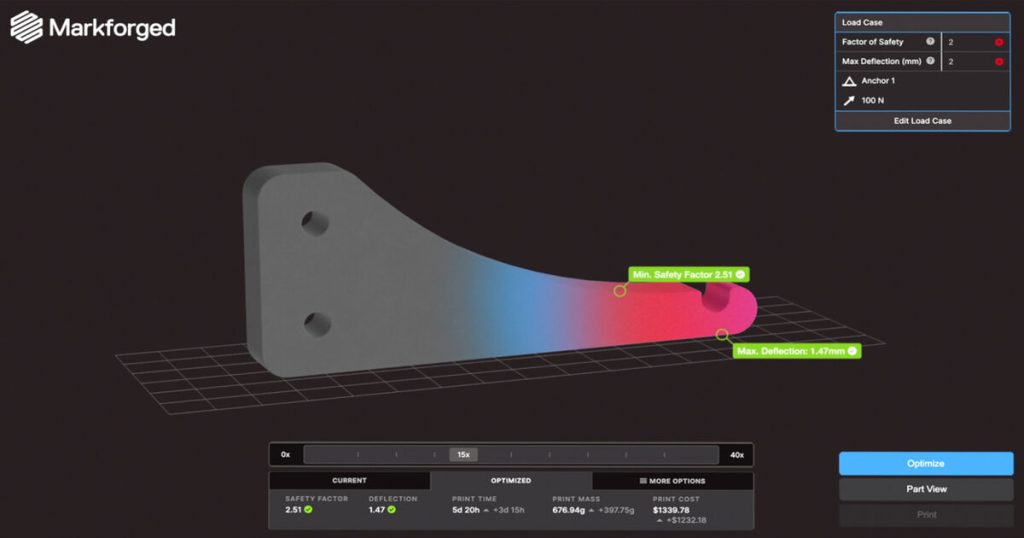
In today’s complex additive manufacturing landscape, simulating part performance and predicting problems prior to 3D printing is the optimal way to keep ahead of the competition. Simulation tools help to ensure expected results by validating designs and optimising settings for more efficient builds.  The use of 3D part simulation is

3D Part Simulation Creates Efficient Builds With Less Waste Read More »

Infill and save drone weight

Make 3D Prints Stronger. More Durability, Same Great Finish

The strength of 3D printed components is determined by several factors, including the material, printing temperatures, layer height, the infill pattern and density, and any post-processing techniques employed. While printing stronger parts is sometimes as simple as switching to a stronger material, other measures like increasing layer thickness can have

Make 3D Prints Stronger. More Durability, Same Great Finish Read More »

Formlabs Fuse 1 3D printed bicycle seat.

What is DfAM? How Design for AM Elevates Product Development

Designing a part for additive manufacturing requires different considerations than subtractive processes like injection moulding and machining due to the underlying technology. Enter DfAM. Design for Additive Manufacturing (DfAM) is a set of design strategies that enhance the manufacturability and cost-efficiency of 3D-printed parts. DfAM uses 3D printing to its

What is DfAM? How Design for AM Elevates Product Development Read More »

metal additive manufactured part

Utilising Metal Additive Manufacturing to Expand Your Build Potential

Metal additive manufacturing can replace traditional manufacturing techniques like machining, drawing, and casting with a digital workflow that enables the production of previously impossible geometries and detail.  Where metal 3D printing really comes into its own is when working with tight tolerances, irregular shapes, thin walls and hollows, and internal

Utilising Metal Additive Manufacturing to Expand Your Build Potential Read More »

3d printing titanium

3D Printing Titanium – Is It Worth the High Investment Cost?

Titanium is a highly valued material in engineering, high-performance product fabrication, and medical applications due to its biocompatibility and superior strength-to-weight ratio. It produces parts 3 to 4 times stronger than stainless steel with a higher melting point. Titanium’s high mechanical strength and corrosion resistance have led the aerospace industry

3D Printing Titanium – Is It Worth the High Investment Cost? Read More »

markforged ULTEM 9085 filament spool

What Is ULTEM™ 9085? Fresh Capabilities with the Markforged FX20

ULTEM™ 9085 is a PEI thermoplastic with a high strength-to-weight ratio and desirable flame, smoke, and toxicity (FST) characteristics.  It is a go-to engineering material in demanding industries like aerospace, automotive, and oil & gas for high-temp tooling, functional prototypes, and high-value production parts that must meet or exceed industry

What Is ULTEM™ 9085? Fresh Capabilities with the Markforged FX20 Read More »