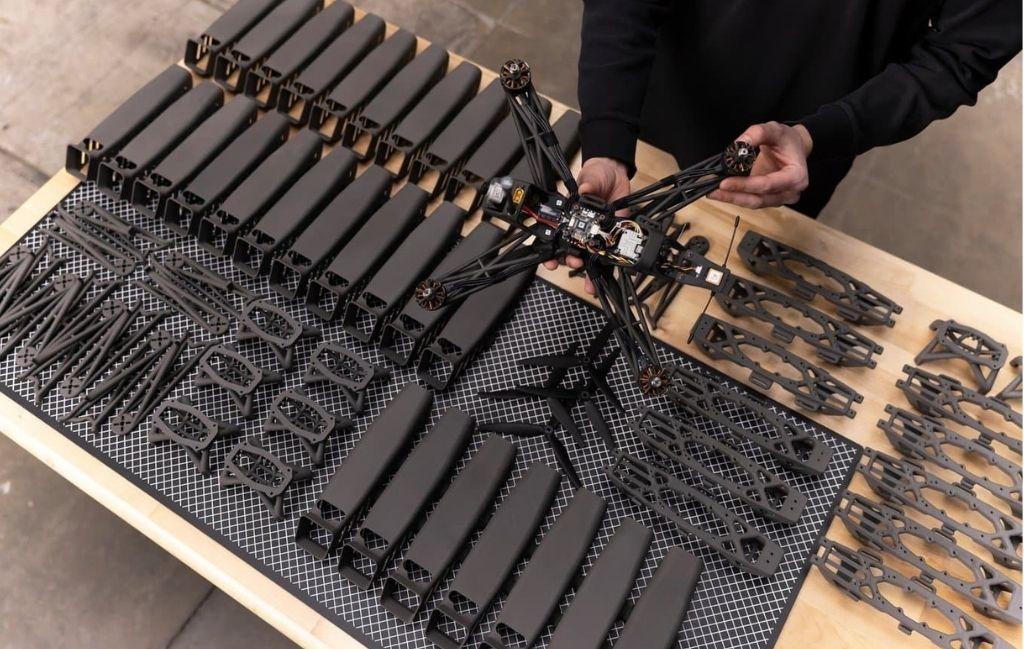




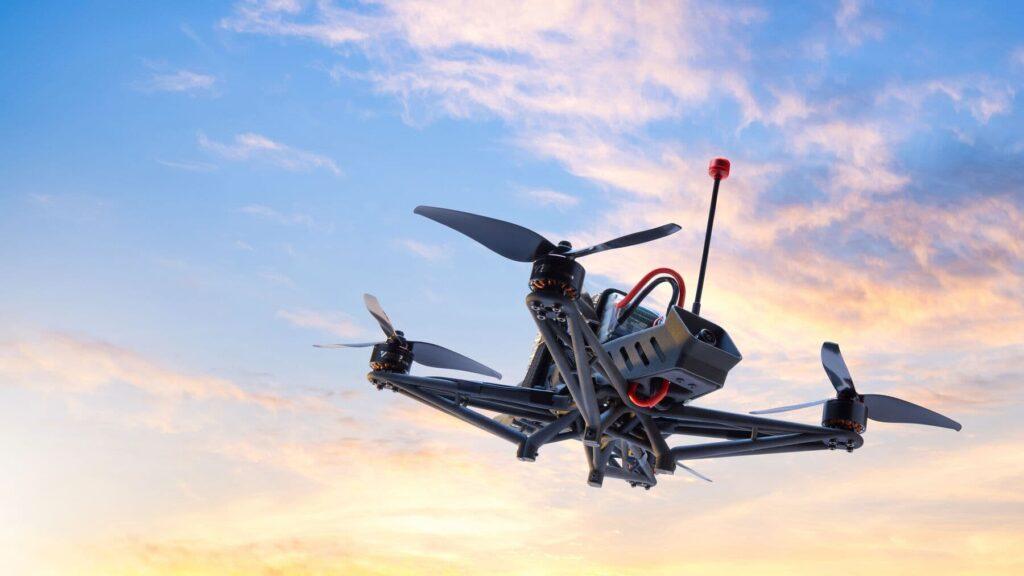
Drone manufacturers and hobbyist builders are turning to 3D printing because it solves a problem traditional manufacturing struggles with: producing complex, lightweight geometries quickly and without expensive tooling. Whether you are prototyping a new frame design or producing custom mounts for a commercial fleet, additive manufacturing has become a genuine part of the drone development process rather than a novelty.
This article covers where 3D printing fits into drone production, which materials actually survive a crash, and how you can see the technology working in person at one of the UK’s biggest drone events this year.
Why 3D printing suits drone manufacturing
Drone parts tend to share three demands: low weight, complex internal geometry and fast iteration. A 3D printer handles all three well.
- Rapid prototyping. A new frame or mount design can go from CAD file to a test part in hours, not weeks. That speed matters when a design change might only be a 2mm adjustment to a motor mount.
- Weight reduction. Every gram on a drone affects flight time and payload capacity. 3D printing allows internal lattices and hollowed sections that cut weight without cutting strength, something CNC machining cannot easily achieve.
- Custom geometry. Camera cages, antenna holders and sensor mounts are often one-off or low-volume parts. Printing them on demand avoids the cost of injection moulding tooling for a part you might only need 20 of.
- Crash economics. A printed arm or mount that breaks costs a few pounds in filament to replace. A damaged carbon fibre plate or machined bracket is a far more expensive repair.
Best materials for 3D printed drone parts
Not every filament belongs on a drone. Standard PLA is too brittle for structural parts and will shatter on impact, so material choice depends entirely on what the part does and where it sits on the airframe.
Part | Recommended material | Why |
Frame arms and body | PA-CF (nylon with carbon fibre fill) | Matches carbon fibre plate stiffness, yields rather than shatters on impact |
Motor mounts and landing gear | Nylon (PA6 or PA12) | High tensile strength, absorbs repeated hard landings without fracturing |
Camera mounts and vibration dampers | TPU | Flexible enough to absorb vibration and protect sensitive electronics |
Outdoor enclosures and housings | ASA | UV resistant, holds up to repeated outdoor use where PETG would degrade |
Rapid prototypes and fit checks | PETG or PLA | Fast, cheap iteration before committing to a structural material |
Peer-reviewed research on composite filaments backs this up, showing carbon fibre-infused PLA, PETG and nylon all improve strength-to-weight performance and dimensional stability for UAV components.
Carbon fibre reinforced nylon has become the standard for structural drone parts because it combines strength with low weight, but it comes with a catch. It is hygroscopic, so it needs drying at 60 to 80°C for 8 to 12 hours before printing, and it requires a hardened steel nozzle because the fibres wear through standard brass ones quickly. Post-processing, usually sanding, is also needed to remove sharp carbon fibre edges before the part goes anywhere near skin or fabric.
You can browse our full range of Bambu Lab filament, including carbon fibre and TPU options, or get in touch if you are not sure which material suits your part.
Matching the printer to the part
Different printer technologies suit different stages of drone development.
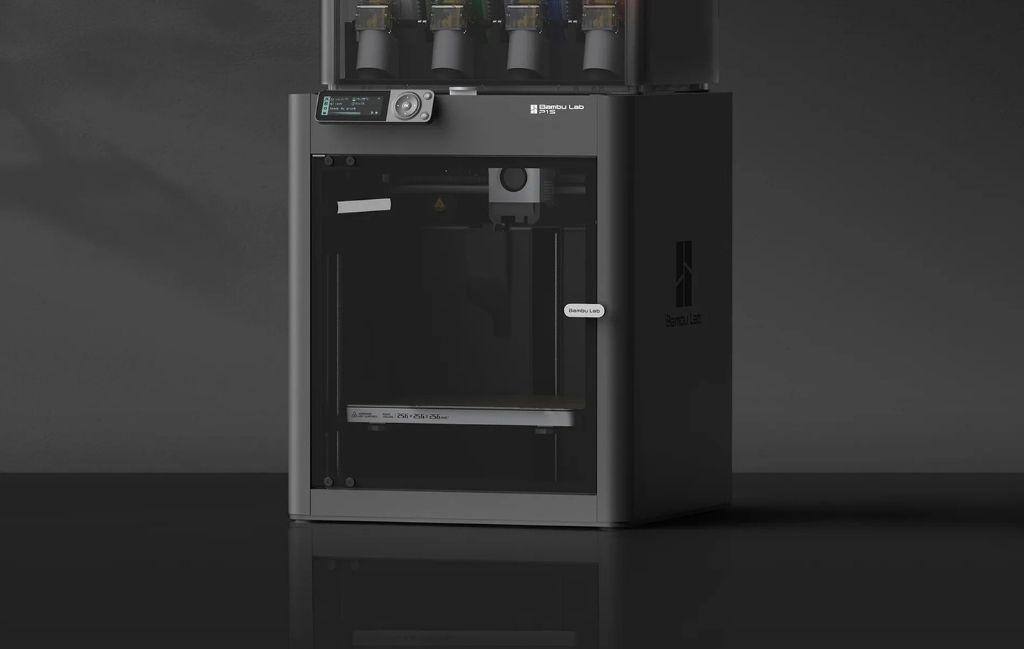
FFF (Fused Filament Fabrication) printers such as those in the Bambu Lab range handle the majority of drone parts, from PETG prototypes through to carbon fibre nylon frames on enclosed, high-temperature models such as the Bambu Lab P1S. For parts that need continuous fibre rather than chopped fibre reinforcement, Markforged printers use CFR (Continuous Fibre Reinforcement) to lay unbroken strands of carbon fibre through a part, giving structural components strength closer to machined aluminium while staying significantly lighter.
For rapid, high-detail prototyping, particularly for small components like sensor housings or connector brackets, resin printers using SLA (Stereolithography) from Formlabs produce a smoother surface finish straight off the printer, cutting down on post-processing time before a design is tested in the field.
If you are weighing up which route suits your build, our team can talk you through material and printer choice, or you can request a 3D printed sample to test strength and finish before committing.
Where to see it in action: DroneX 2026
If you want to see drone technology and additive manufacturing applications up close, DroneX 2026 takes place at ExCeL London on 29 and 30 September. It is the UK’s largest dedicated drone trade show and conference, bringing together operators, manufacturers and technology providers across commercial, infrastructure, emergency services and defence applications. Expect live demonstrations, exhibitor stands covering the full UAV supply chain and sessions on where drone design is heading next, including the growing role of on-demand and additive manufacturing in getting parts from design to flight faster.
Events like this are a good opportunity to see printed components in real drones rather than just on a spec sheet, and to talk to people building at scale about what has and has not worked for them.
Getting started with your own drone parts
If you are building or maintaining a drone fleet and want to bring part production in-house, start with the material, not the printer. Work out what each part needs to survive, whether that is repeated hard landings, UV exposure or simply getting from CAD to a test flight as quickly as possible, and choose accordingly.
Our team stocks and supports the printers and materials covered here, from Bambu Lab through to Markforged and Formlabs, and can help you work out what fits your build. Get in touch or visit our shop to browse materials and machines suited to drone production.