




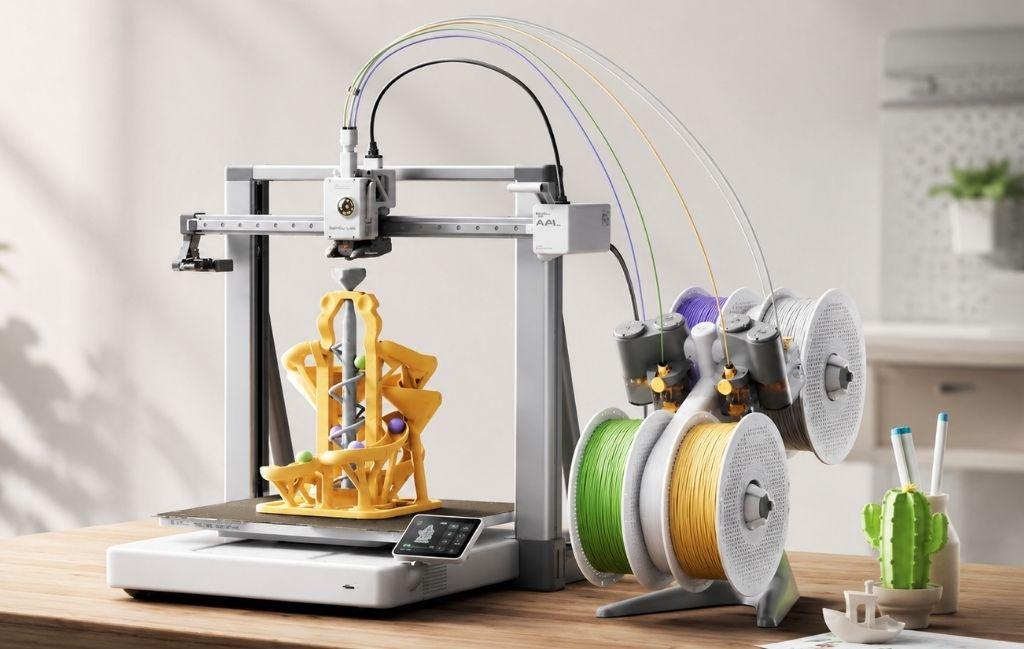
The Bambu Lab A2L addresses a specific gap that a lot of makers, small businesses and schools run into eventually: needing to print parts bigger than a standard desktop machine’s build plate allows. Whether that’s a large enclosure, a batch of identical parts in a single print, or simply oversized props and prototypes, build volume matters more than people often expect until they hit the limit themselves.
It’s a limit that tends to arrive at the worst possible moment, halfway through designing a part, when you realise the model needs splitting into sections, glued or bolted back together, with a visible seam running straight through what should have been a clean single piece. For batch work, the same ceiling shows up as more print jobs, more time spent starting and monitoring runs, and more opportunities for something to go wrong partway through. A larger build plate doesn’t just print bigger objects, it removes an entire category of workaround from the process.
This buying guide covers what the Bambu Lab A2L actually offers, who genuinely benefits from the larger build volume, and what to weigh up before choosing it over a smaller, more compact printer.
What "Large Bed" Actually Means Here
Build volume is measured as the maximum size of object the printer can produce in one piece, expressed as width, depth and height. The Bambu Lab A2L extends this significantly beyond a typical compact desktop printer, opening up parts and projects that simply wouldn’t fit on a smaller machine without being split into sections and glued or bolted together afterward.
That sounds like a small detail, but for a lot of practical applications it changes the entire project. A single-piece bracket is stronger and faster to produce than the same bracket split into two parts and joined. A large enclosure printed in one go avoids visible seams and assembly steps.
Who Actually Benefits From a Larger Build Volume
Batch production
If you’re printing multiples of the same smaller part, a larger bed lets you fit more of them into a single print run. Rather than running four separate prints of ten parts each, you might fit all 40 onto one build plate, reducing total time spent starting, monitoring and finishing print jobs.
Large single parts
Enclosures, large brackets, props, and oversized prototypes that would otherwise need to be split into sections and joined print as a single piece. This avoids weak points at the join lines and saves the assembly time and finishing work needed to make a multi-part print look and perform like a single component.
Schools and education
Larger class projects, life-size or near-life-size models, and batch printing of student projects all benefit from extra build volume. A classroom running multiple students’ designs through a single printer gets more throughput from a larger bed without needing additional machines.
Small business production runs
For businesses producing batches of products, signage or parts, fitting more onto each build plate reduces the number of separate print jobs needed to fulfil an order, which matters for both time and consistency across a production run.
What to Actually Check Before Buying
Does your typical work actually need the extra volume?
It’s worth being honest here. If most of your prints are small parts that comfortably fit a standard desktop build plate, the extra volume of the Bambu Lab A2L may not change your day-to-day workflow much, and a smaller printer could represent better value. The benefit is clearest for people who regularly hit the size limit of a standard machine, whether that’s single large parts or batch production runs.
Print speed at full bed capacity
A larger bed means longer prints when it’s filled to capacity, simply because there’s more material to lay down. Worth factoring that into your expectations around turnaround time, particularly for batch jobs that fill the entire plate.
Space and workshop footprint
A larger build volume generally means a larger overall machine footprint. Check the printer’s physical dimensions against your available workshop or office space before committing, particularly if space is already tight.
Material costs for larger prints
Bigger parts and bigger batches use more filament. It’s not a downside exactly, since you’re getting more output per print, but it’s worth budgeting filament costs accordingly rather than being caught out by consumption on a full-bed print.
Key Features Worth Understanding
Multi-material compatibility
Like other Bambu Lab printers, the A2L pairs with the AMS (Automatic Material System) for multi-colour and multi-material printing, useful for larger projects that benefit from colour-coded components or combine rigid and flexible materials in a single build.
Print quality at scale
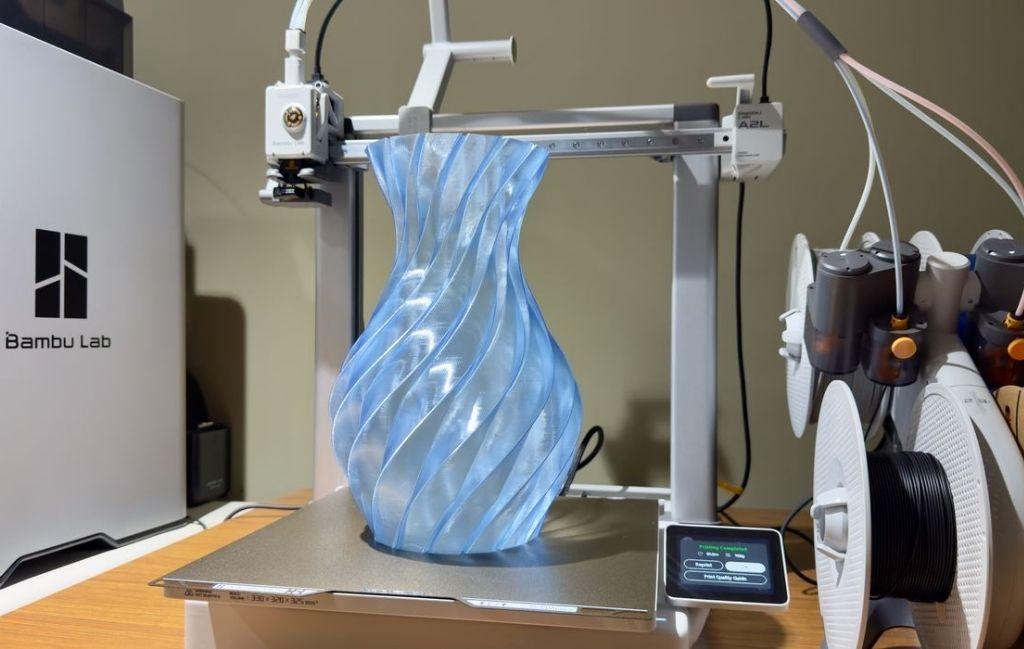
A larger build volume doesn’t automatically mean a compromise on detail or surface finish. The same precision that smaller Bambu Lab printers are known for carries through to larger prints, provided settings are dialled in correctly for the specific material and part geometry.
Reliability for long prints
Larger prints generally mean longer print times, sometimes running for many hours or even overnight. Reliable bed adhesion, consistent extrusion and dependable cooling all matter more on a long print, since a failure partway through wastes significantly more time and material than on a quick, small print.
Consideration Standard Desktop Printer Bambu Lab A2L
Consideration | Standard Desktop Printer | Bambu Lab A2L |
Single large parts | Needs splitting and joining | Prints as one piece |
Batch production | Fewer parts per run | More parts per run |
Workshop footprint | Smaller | Larger |
Material use per print | Lower for small parts | Higher for full-bed prints |
Best suited to | Small, occasional prints | Regular batch work or large parts |
Frequently Asked Questions
Is the Bambu Lab A2L worth it for occasional large prints?
If large prints are rare for you, renting time on a larger printer or having a one-off part produced elsewhere might make more financial sense than buying a larger machine outright. If large or batch prints are a regular part of your workflow, the time saved on assembly and the throughput gained from batch printing usually justifies the investment.
Does a bigger build plate mean slower prints overall?
Not inherently. A single small part will print at a similar speed regardless of the printer’s maximum build volume. It’s only when the full plate is being used for a large part or a big batch that total print time increases, simply because there’s more total material being deposited.
Can the A2L still produce fine detail on smaller parts?
Yes. Build volume and print resolution are separate considerations. A larger bed doesn’t compromise the printer’s ability to produce fine detail on smaller individual parts when that’s what’s needed.
Final Thoughts
The Bambu Lab A2L makes the most sense for anyone regularly producing large single parts, running batch print jobs, or working in an education or small business setting where throughput and part size both matter. For occasional small prints, a standard desktop printer may still be the more sensible and cost-effective choice.
If you’re on the fence, think honestly about how often you’ve had to split a design across multiple prints purely because of bed size, or how much time batch production would save with more parts per build. Speak to our team about whether the A2L fits your typical workload before committing.