




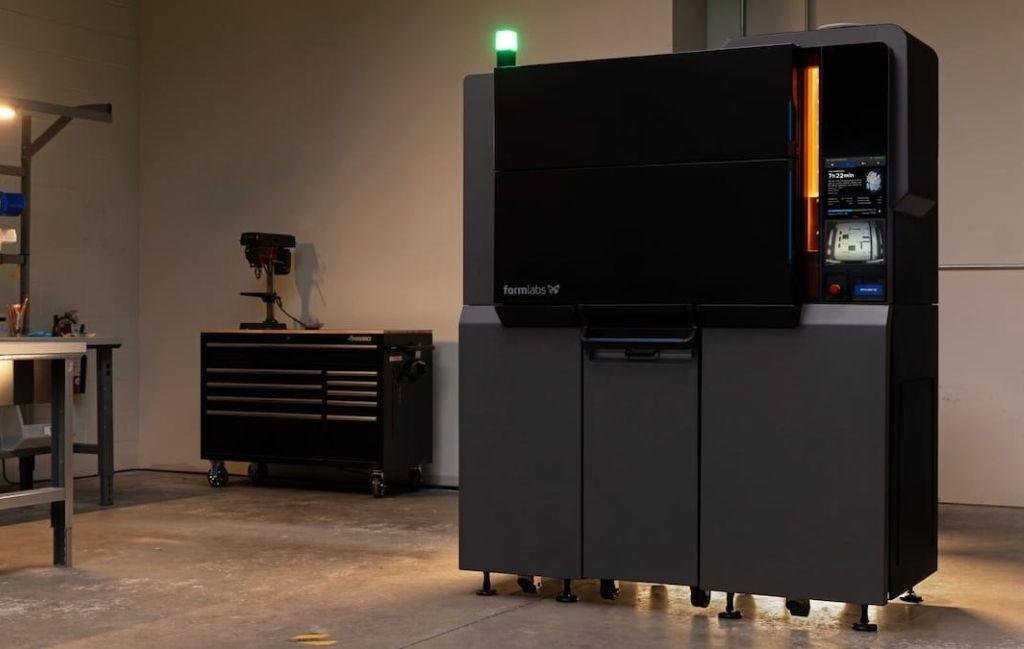
The Formlabs Fuse X1 sits at an interesting point in the market. It uses SLS (Selective Laser Sintering), a process traditionally associated with six-figure industrial systems, but at a price and footprint that engineering teams, manufacturers and service bureaus can realistically justify once they need real scale.
SLS earned its reputation for producing strong, support-free, production-grade nylon parts, but for years the machines capable of it lived firmly in large manufacturing facilities. Formlabs already changed that equation once with the Fuse 1+, its compact desktop SLS printer that brought support-free nylon printing within reach of smaller teams and workshops for the first time. The Fuse X1 builds on that same foundation, but it is not a cheaper way in. It is a large-format step up, aimed at teams who have already proven out SLS on a Fuse 1+ (or elsewhere) and now need bigger parts, bigger batches or faster turnaround.
What follows looks at what the Fuse X1 actually does, how it compares to both the Fuse 1+ and traditional industrial SLS systems, and where it earns its keep as a genuine production tool.
What SLS Actually Does
SLS uses a laser to selectively fuse powdered nylon material, layer by layer, within a bed of unfused powder. The surrounding powder supports the part during printing, which means SLS parts need no support structures at all, unlike FFF (Fused Filament Fabrication) or SLA (Stereolithography) printing. This makes SLS particularly good for complex geometries, including parts with internal cavities, interlocking assemblies and fine lattice structures that would be difficult or impossible to support with other processes.
Fuse X1 vs Fuse 1+: Not the Same Decision
It is worth being clear on this up front, because the two machines solve different problems.
The Fuse 1+ is Formlabs’ compact desktop SLS printer, with a 165 × 165 × 300 mm build volume and a 30W fibre laser. It remains the accessible entry point into in-house SLS for teams printing smaller parts in modest batches. See our full specification breakdown for more detail.
The Fuse X1 has a 330 × 330 × 565 mm (61.5 litre) build volume, around 7.5 times that of the Fuse 1+, and a 120W fibre laser. It is built for large parts, dense batch nesting (30%+ packing density) and throughput that a desktop machine simply cannot match. It is a genuine step up in capability, footprint and investment, not a budget alternative.
For a team already running a Fuse 1+ and hitting its limits on part size or volume, the Fuse X1 is the natural next machine. For a team taking its first step into SLS with lower part counts, the Fuse 1+ is usually still the sensible starting point.
Where the Fuse X1 Fits
Production-grade parts, not just prototypes The Fuse X1 produces nylon parts strong enough for genuine functional and end-use applications, not just visual prototypes. Brackets, housings, jigs and low-volume production parts are realistic outputs, with mechanical properties that hold up under real-world use.
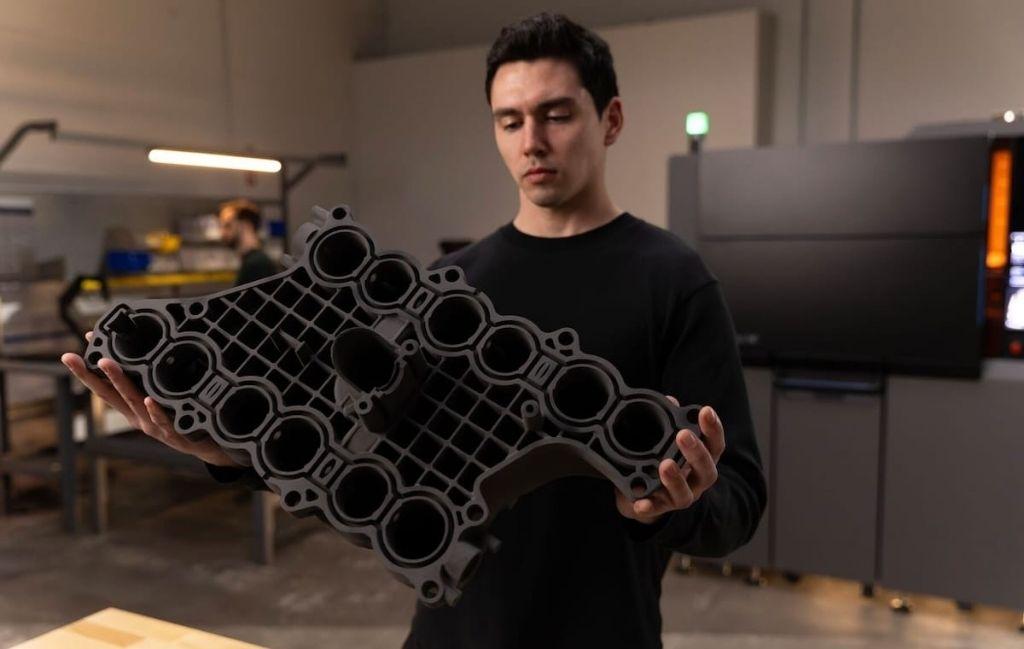
A much larger build volume With roughly 7.5 times the build volume of the Fuse 1+, the Fuse X1 allows far more parts per print run or larger individual components (up to 713 mm in a single piece), cutting down on the sectioning and gluing that large parts previously required.
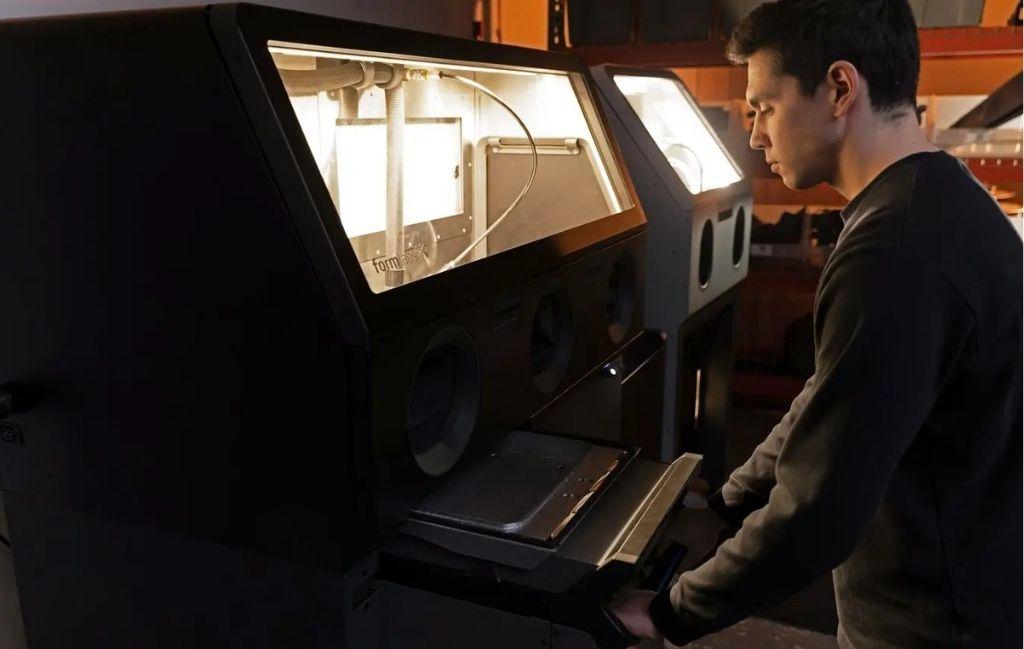
Faster throughput for busy workflows Formlabs positions the Fuse X1 as offering several times the throughput of the Fuse 1+ thanks to its higher-power laser and denser packing. Paired with the Fuse Sift X1 for powder recovery, it reduces the bottleneck between design and finished part for teams running SLS as a genuine production line.
How It Compares to Traditional Industrial SLS Systems
Price point Traditional industrial SLS machines have historically required investments well into six figures, putting them out of reach for most small and medium engineering teams. The Fuse X1 sits meaningfully below that, though it is a larger investment than the Fuse 1+, positioned for teams that need genuine large-format, high-volume capability rather than an entry-level setup. Formlabs’ own Fuse X1 announcement covers the full ecosystem and positioning in more detail.
Footprint and facility requirements Industrial SLS systems often need dedicated facility space, specific power requirements and trained operators running a full production line. The Fuse X1 is designed to fit through a standard doorway and run on single-phase power, without the facility overhead of the largest industrial systems, despite its considerably larger build volume than the Fuse 1+.
Materials available The material range on the Fuse X1 won’t match the full breadth available on the largest industrial machines, but the core nylon materials it supports cover the majority of functional, end-use applications that growing teams need.
What Makes SLS Different From Resin or FFF Printing
No support structures needed Because the surrounding powder bed supports the part during printing, geometries that would need extensive support structures in FFF or SLA printing can be printed with no supports at all in SLS. This matters enormously for complex assemblies, interlocking parts and lattice structures.
Genuinely isotropic mechanical properties SLS parts tend to have more consistent mechanical properties across different orientations compared to FFF parts, where layer adhesion can create a weaker direction through the part. This makes SLS parts more predictable for load-bearing applications regardless of how they’re oriented in the build.
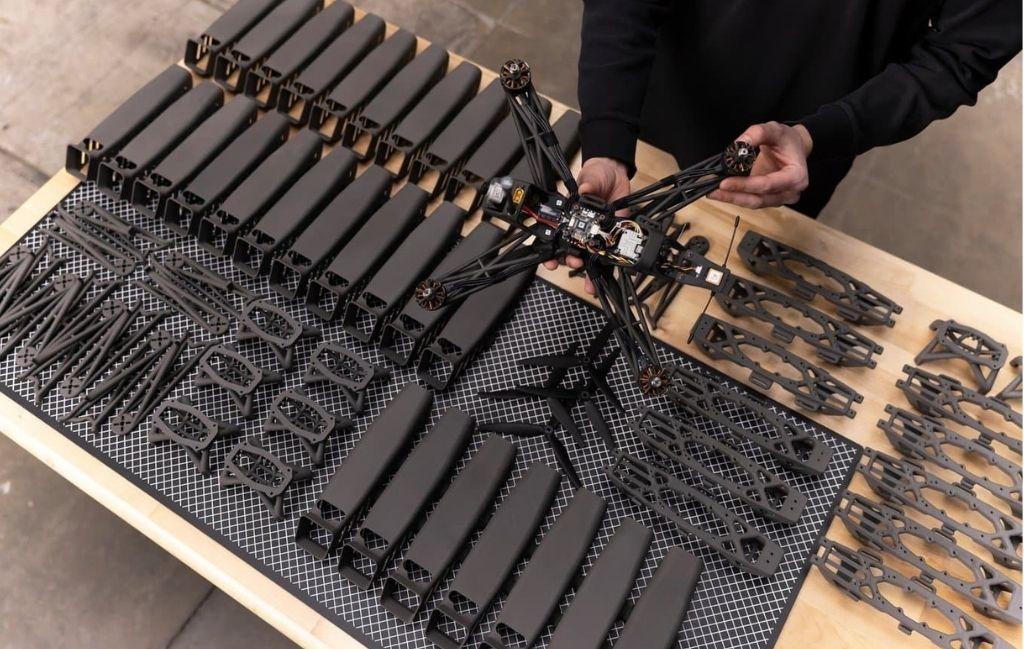
Batch production in a single build Because parts don’t need supports and can be nested closely together within the powder bed, a single SLS build can produce far more parts simultaneously than an equivalent FFF or SLA print run. On the Fuse X1, that packing density runs above 30%, well beyond the levels typically achievable with other powder-based systems.
Practical Applications for the Fuse X1
- Large functional prototypes that need to survive genuine mechanical testing, not just visual review
- Higher-volume production runs of brackets, housings and enclosures
- Jigs and fixtures for manufacturing lines, particularly complex or oversized geometries
- Interlocking or assembled parts printed in a single build without needing post-print assembly
- Service bureau work at scale, where throughput and part quality both need to be reliably high
If your part sizes and batch volumes are smaller, the Fuse 1+ covers the same core SLS advantages (no supports, isotropic strength, batch nesting) at a lower entry cost and smaller footprint.
What to Consider Before Buying
Post-processing requirements SLS parts come out of the printer embedded in unfused powder, requiring depowdering before they’re ready to handle or finish. This needs proper equipment and a clear process, particularly for parts with internal channels or cavities where trapped powder needs to be fully removed.
Powder handling and reuse SLS uses unfused powder around the part as support, and that powder is partially reusable across multiple builds, though not indefinitely. Understanding the powder refresh ratio and associated material cost matters for working out the true cost per part over time.
Training and process control Getting consistent results on any SLS system, including the Fuse X1, still benefits from a team member who owns the process, understands the powder handling requirements, and maintains consistent settings across builds. Additive-X’s technical support and 3D printing service are both available if you want that expertise on tap rather than in-house from day one.
Matching the machine to your volume Because the Fuse X1 is a larger investment and a larger machine than the Fuse 1+, it is worth working out your realistic part size and monthly volume before choosing between the two. Buying more capacity than you need adds cost without adding value.
Frequently Asked Questions
What’s the difference between the Fuse X1 and the Fuse 1+? The Fuse 1+ is Formlabs’ compact desktop SLS printer with a smaller build volume and lower price, suited to smaller parts and modest batch sizes. The Fuse X1 is a large-format industrial system with around 7.5 times the build volume, a more powerful laser and significantly higher throughput, built for larger parts and higher-volume production.
How does the Fuse X1 compare to FFF printing for functional parts? For complex geometries, batch production and parts needing isotropic mechanical properties, SLS generally outperforms FFF. For simple, single parts where speed and low cost matter more than complexity, FFF can still be the more practical choice.
What’s the realistic cost per part on a Fuse X1? It depends heavily on part size, batch density and material, but the ability to nest many parts into a single build without support structures generally brings the cost per part down considerably compared to single-part SLA or FFF printing at similar volumes.
Does this replace the need for an external SLS service bureau? For many teams, yes, particularly if part volume and part size are consistent enough to justify in-house equipment. For occasional or highly specialised SLS needs, an external bureau may still make sense alongside in-house capability.
Final Thoughts
The Formlabs Fuse X1 makes a genuine case for bringing large-format SLS capability in-house for teams that have outgrown a desktop system or previously assumed that scale meant a six-figure machine. If you’re already running a Fuse 1+ and hitting its limits on part size or batch volume, or you’re outsourcing large SLS parts because your current printers can’t handle them, it’s worth running the numbers on what the Fuse X1 would cost against your current volume.
If your needs are still closer to smaller parts and lower batch counts, the Fuse 1+ remains the more sensible starting point.
Book a demo to see real parts coming off a Fuse X1 before deciding.