




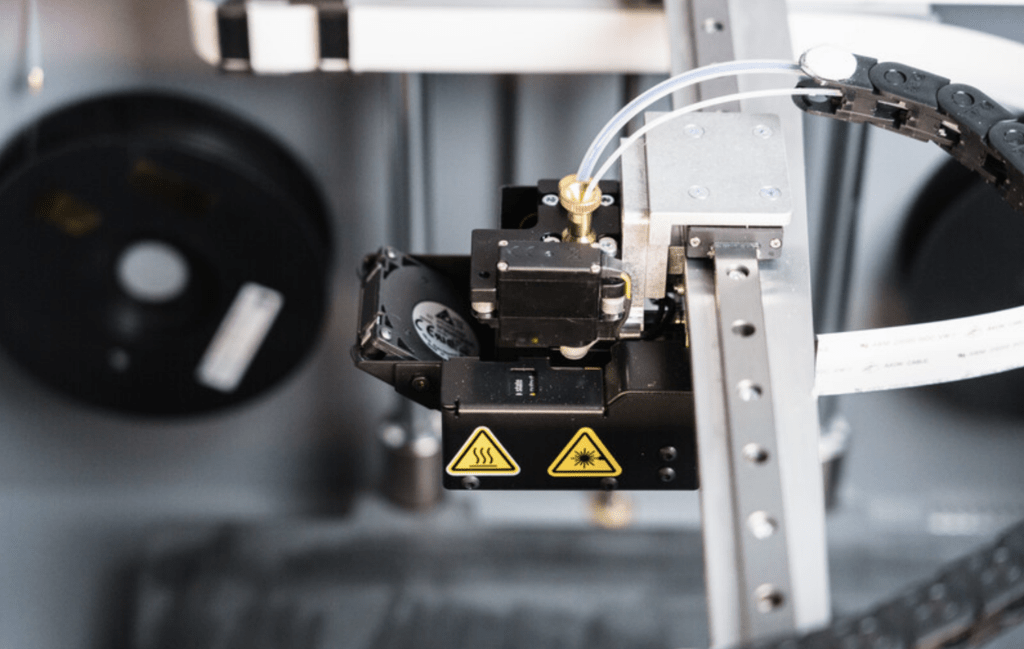
Composite 3D printing has reached a point where it can genuinely replace metal parts in some engineering and manufacturing applications, not just prototype them. Markforged has built its entire product range around this idea, embedding continuous carbon fibre into printed plastic parts to produce components that rival aluminium in strength-to-weight terms.
For a long time, that claim would have been marketing talk. It isn’t anymore. Engineering teams across robotics, automotive and manufacturing are now specifying printed composite parts on production lines, not just for early-stage prototypes that get thrown away once the real metal part arrives. The shift has happened quietly, largely because the parts work, hold their dimensions, and survive the loads they’re put under.
This matters to anyone specifying parts for jigs, fixtures, brackets or low-volume production runs. If metal machining is your default choice purely out of habit rather than necessity, composite 3D printing is worth understanding properly before your next project, because the cost and lead time difference on the right part can be substantial. This article covers how the process works, where it genuinely competes with metal, and where it doesn’t, so you can make that call on the facts rather than the hype.
What Composite 3D Printing Actually Is
Standard FFF (Fused Filament Fabrication) printing extrudes plastic filament layer by layer. Composite 3D printing adds a second print head that lays continuous strands of fibre, typically carbon fibre, fibreglass or Kevlar, directly into the plastic matrix as it prints. This is CFR (Continuous Fibre Reinforcement), and it’s the core technology behind Markforged’s industrial printers.
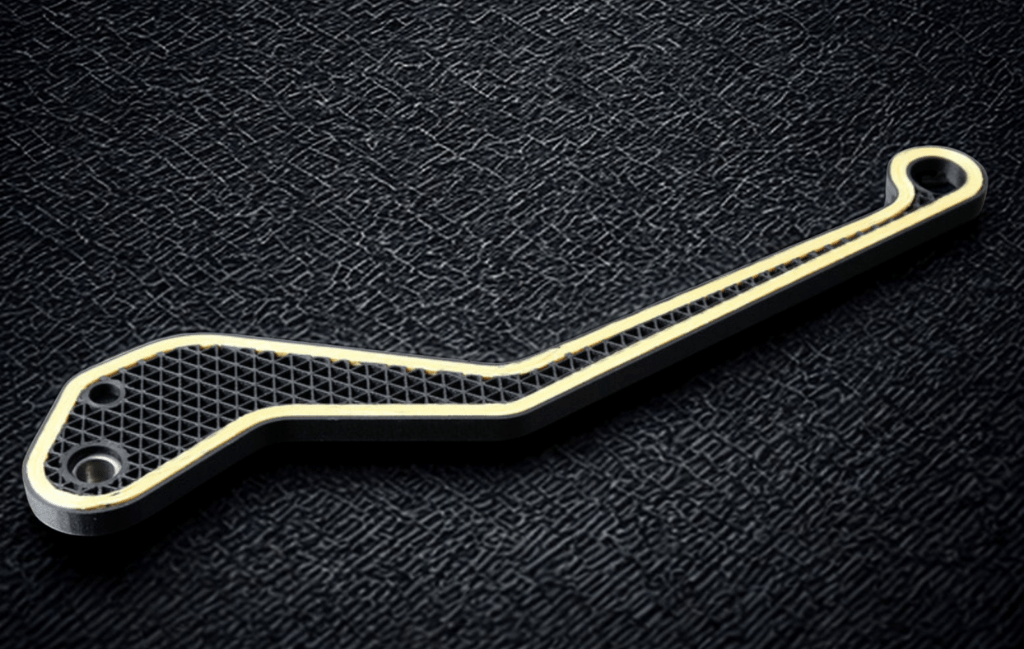
The fibre placement follows the load paths in the part, reinforcing exactly where strength is needed rather than relying on the bulk plastic alone. A bracket under bending load, for example, can have fibre laid along the axis where bending stress is highest, dramatically increasing stiffness without adding much weight.
Why Engineers Are Looking at This Instead of CNC or Metal Casting
Weight without sacrificing strength
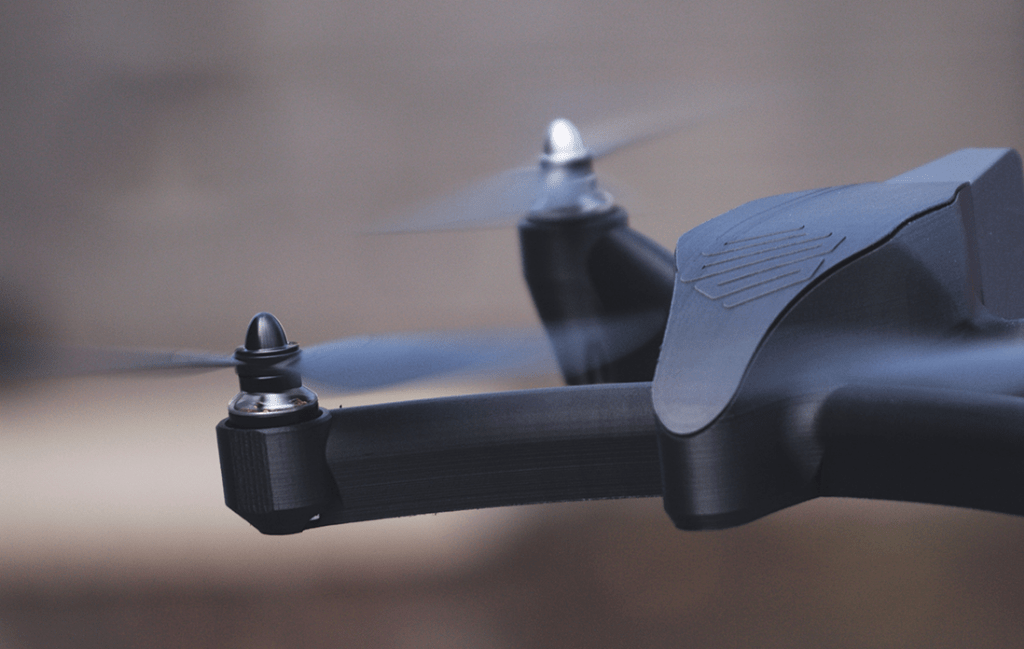
A part reinforced with continuous carbon fibre can achieve strength-to-weight ratios that compete with aluminium, while weighing significantly less than a solid metal equivalent. For applications like robotic end-effectors, drone components or automotive jigs, that weight saving translates directly into performance.
Speed for low-volume parts
Machining a custom metal bracket means programming a CNC (Computer Numerical Control) machine, sourcing stock material, and running a cutting cycle that could take hours per part. A composite 3D printing equivalent can often be designed and printed within a day, with no tooling and no machine setup beyond loading the material.
No tooling costs
Injection moulding and metal casting both require tooling that costs thousands of pounds before you produce a single part. For runs under a few hundred units, that tooling cost rarely makes sense. Composite 3D printing has no tooling step at all, which makes low-volume and one-off parts economical in a way metal manufacturing usually isn’t.
Design freedom
Metal machining removes material from a solid block, which limits what geometries are practical. Composite 3D printing builds up material, so internal channels, complex lattices and consolidated assemblies (multiple parts combined into one print) become realistic options.
Where Metal Still Wins
Composite 3D printing isn’t a universal replacement for metal, and being honest about its limits matters more than overselling the technology.
- High continuous temperatures. Most printed composite parts are not suited to sustained exposure above 150°C, where many metals handle far higher.
- Extreme load cycling. Metal fatigue behaviour is well understood and predictable over millions of cycles. Composite parts can perform well but the long-term fatigue data is less mature.
- Very high precision tolerances. CNC machining still holds tighter tolerances than printing for some applications, particularly where mating surfaces need to be machined to a few microns.
- Very high production volumes. Once you’re producing thousands of identical parts, traditional manufacturing methods generally become more cost-effective per unit.
Real Applications Where This Replaces Metal Today
Jigs and fixtures
Manufacturing jigs and fixtures are a near-perfect fit for composite 3D printing. They’re typically low-volume, custom to a specific job, and benefit from being lightweight for operators handling them repeatedly. A jig that used to be machined from aluminium can often be printed in a fraction of the time at a fraction of the cost, while holding the dimensional accuracy needed for the job.
Brackets and mounting hardware
Brackets under moderate load, particularly in robotics, automation and motorsport applications, are routinely printed in carbon fibre reinforced nylon instead of machined aluminium. The weight saving matters in moving systems, and the design freedom allows brackets to be consolidated into single parts that would previously have needed several machined components bolted together.
End-of-arm tooling
Robotic grippers and end-effectors benefit from low mass, since every gram of tooling weight reduces the payload capacity of the robot arm. Composite 3D printing produces tooling that’s stiff enough to hold position accurately while being significantly lighter than a machined metal equivalent.
What This Means for Your Manufacturing Process
Material selection
Markforged offers several reinforcement options, each suited to different applications. Carbon fibre gives the highest stiffness. Fibreglass offers a good balance of strength and cost. Kevlar provides impact resistance for parts that need to absorb shock rather than stay perfectly rigid. Choosing the right fibre for the application matters as much as choosing where to place it in the part.
Software and design considerations
Markforged’s design software lets engineers specify exactly where fibre reinforcement goes within a part, rather than leaving it to a generic infill pattern. This means parts need to be designed with their load case in mind from the start, not simply printed as a like-for-like substitute for a machined drawing.
Cost comparison in practice
A typical aluminium bracket, machined to order in low volume, might run to £150 to £300 per part once setup and machining time are accounted for. A composite-printed equivalent, depending on size and fibre content, often comes in well below that, with the gap widening further for genuinely one-off or highly custom geometries where machine setup time dominates the cost.
Getting Started With Composite 3D Printing
Moving from machined metal to composite 3D printing doesn’t have to mean replacing your entire parts catalogue at once. Most engineering teams start with a single application, often a jig or fixture that’s due for replacement anyway, and use it as a test case. Printing a direct comparison part alongside the existing machined version gives a real basis for comparing weight, cost and lead time on a part you already understand.
From there, it’s worth building a simple internal checklist for which parts are good candidates: low to moderate continuous temperature, predictable load direction, low to moderate production volume, and a benefit from reduced weight or faster turnaround. Parts that tick most of those boxes are usually strong candidates. Parts that need extreme temperature resistance, very tight tolerances or very high volumes are better left with traditional manufacturing for now.
Frequently Asked Questions
Is composite 3D printing as strong as aluminium?
For many applications, yes, particularly where the load is predictable and the fibre can be laid along the primary load path. It’s not a blanket replacement for every grade of aluminium in every application, but for brackets, jigs and fixtures it competes well.
What’s the typical lead time compared to CNC machining?
A composite-printed part can often go from design file to finished component within a day, including printing and any minor finishing. CNC machining typically takes longer once programming, setup and queue time at a machine shop are factored in, especially for one-off parts.
Do these parts need post-processing?
Some light finishing, such as removing support material and light sanding, is common. Unlike metal parts, there’s no heat treatment or surface coating required for most applications, which simplifies the overall process.
Final Thoughts
Composite 3D printing has earned its place as a genuine engineering material choice, not just a prototyping shortcut. For jigs, fixtures, brackets and tooling where weight, lead time and tooling cost matter more than extreme temperature resistance or microscopic tolerances, it competes directly with metal machining and often wins on cost and speed.
The honest answer is that it won’t replace every metal part in your manufacturing process, and it shouldn’t be expected to. The sensible approach is to look at your current parts list, identify the brackets, jigs and fixtures that don’t need extreme temperature or fatigue performance, and test a few of them as printed composite parts. Request a sample part to see the material quality before committing to a production decision.