




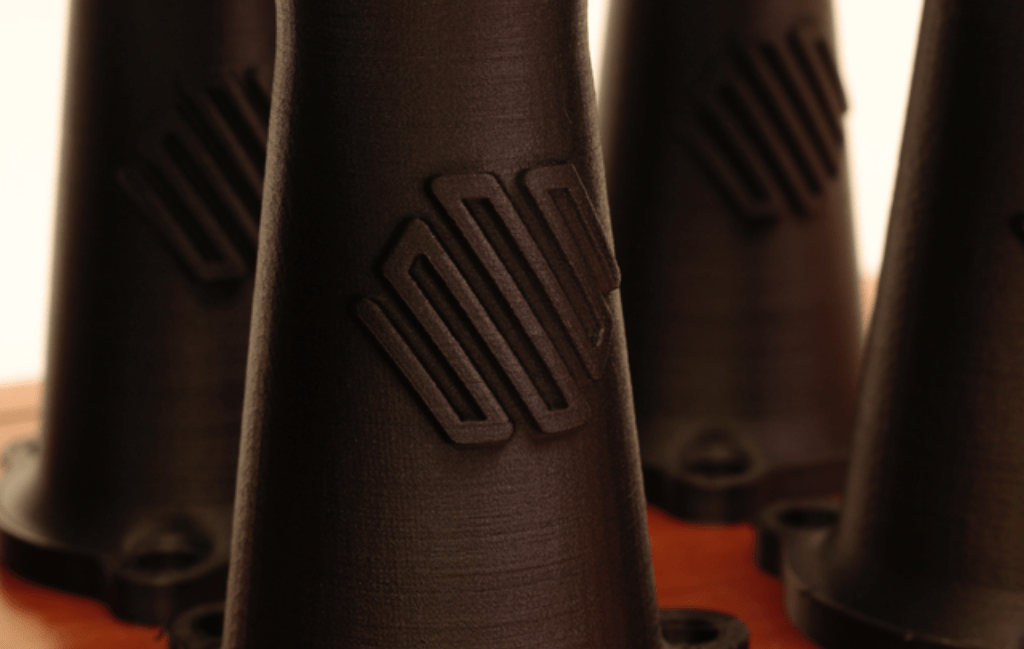
If you’ve been looking at Markforged printers, you’ve almost certainly come across Onyx filament. It’s the base material for most of what Markforged produces, and for good reason. Onyx is a chopped carbon fibre-reinforced nylon that prints with a better surface finish than most FFF (Fused Filament Fabrication) materials and holds up considerably better in real working conditions.
That said, it’s not the right choice for every job. This article covers what onyx 3D filament actually is, how the numbers stack up, which printers run it, and, crucially, the situations where it earns its cost versus those where a cheaper material would serve you just as well.
What Is Onyx Filament, Exactly?
Onyx is nylon filled with short-strand chopped carbon fibre. The nylon gives you toughness and chemical resistance; the carbon fibre adds stiffness. Put together, you get a material that’s around twice as stiff as standard nylon and noticeably stronger than ABS or PLA at equivalent wall thicknesses.
The important distinction to understand early is that the carbon fibre in onyx nylon filament is chopped, not continuous. Short strands improve stiffness and surface quality throughout the part, but they don’t dramatically boost tensile strength the way continuous fibre does. Continuous Fibre Reinforcement (CFR) is a separate Markforged technology, where the printer lays long unbroken strands of carbon, fibreglass, or Kevlar inside the part as it builds. Onyx is the required base material for that process, which is partly why it’s become Markforged’s default starting point for high-performance work on the Markforged platform.
Think of Onyx as doing two jobs: it’s a capable material in its own right, and it’s also the foundation that makes CFR possible.
Onyx Filament Properties: The Numbers
These figures are for standard onyx without any continuous fibre, taken from the Markforged materials datasheet:
- Tensile strength: 35 MPa
- Tensile modulus: 2.4 GPa
- Flexural strength: 81 MPa
- Flexural modulus: 3.8 GPa
- Heat deflection temperature: 145°C (at 0.45 MPa)
- Elongation at break: 25%
Those headline figures are solid, but what often impresses engineers most when they first handle an onyx part is the surface. It comes off the printer with a matte black finish that’s smoother and more consistent than most FFF outputs. For a lot of functional components, that’s good enough to use as-is, without any post-processing.
Chemical resistance is another practical plus. Onyx holds up well against cutting fluids, oils, and common industrial solvents, which makes it useful in workshop and factory environments where other plastics would degrade or discolour quickly.
Which Printers Run Onyx Filament?
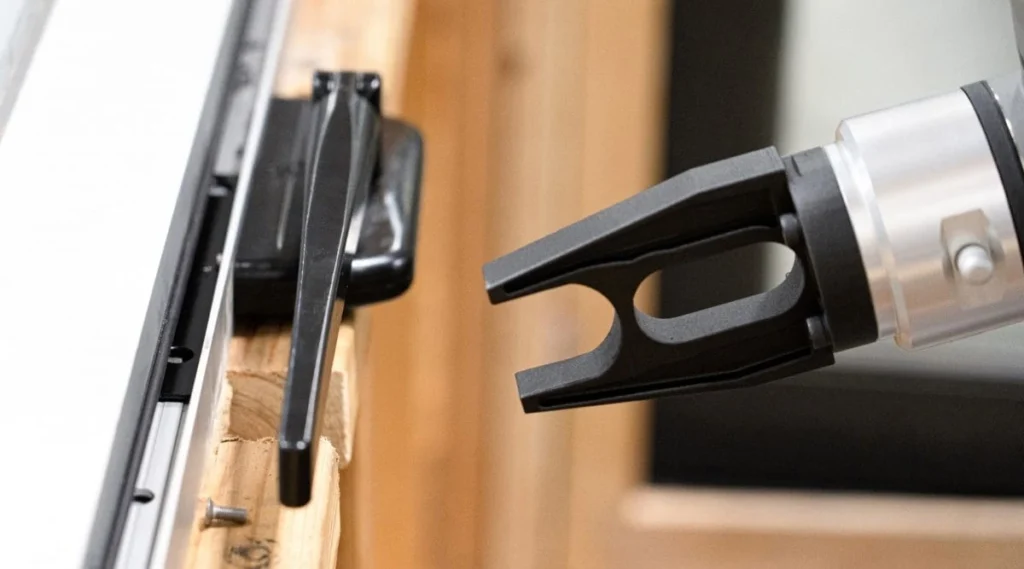
Onyx runs on Markforged’s composite printer range: the Onyx One, Onyx Pro, Mark Two, X3, X5, X7, and the FX10, FX20 for larger industrial parts. The machines aren’t all equal in what they can do with onyx, though. The Onyx One is a pure Onyx printer with no CFR capability. The Mark Two and X series machines add continuous fibre, which is where the performance ceiling rises significantly.
Worth knowing upfront: Markforged operates a closed material system. Onyx filament is proprietary, and it runs through their Eiger slicing software. Eiger handles fill patterns, fibre placement, and part orientation, which reduces setup complexity but also means you won’t be tweaking parameters the way you might on an open-ecosystem machine. You can’t run third-party materials on a Markforged printer, and Onyx itself won’t work on other brands.
For some engineers that’s a frustration; for others, particularly in regulated industries, the consistency and process control it provides is exactly the point.
You can browse Markforged onyx filament on the Additive-X shop, including spools and compatible CFR materials.
How Onyx Nylon Filament Compares to Other Materials
Onyx vs Standard Nylon
Plain nylon is tough and has reasonable chemical resistance, but it drinks moisture, and that causes real problems: print quality suffers, dimensions shift, and parts can weaken over time if not stored properly. Onyx nylon filament is more stable, stiffer, and more consistent to print. If you’re already committed to a nylon-based material, Onyx is the more predictable option.
Onyx vs ABS
ABS has been a go-to functional prototyping material for years, but it warps, it’s not particularly strong, and it doesn’t handle chemicals especially well. Onyx is stiffer and more chemically resistant, and it doesn’t need a heated enclosure to print reliably. The honest trade-off is price: Onyx filament costs considerably more than ABS, and you’re tied to the Markforged ecosystem to use it. For genuine end-use parts, it’s worth it. For a quick functional prototype, probably not.
Onyx vs PETG
PETG is easy to print, reasonably strong, and accessible on almost any FFF machine. For lower-stress applications it does a perfectly good job. Onyx pulls ahead when you need higher stiffness, better heat resistance, or the option to add continuous fibre. If your parts are going somewhere warm or carrying real loads, the gap between PETG and onyx starts to matter.
Onyx vs Other Carbon Fibre-Filled Filaments
There are carbon fibre-filled filaments available for open FFF printers, and some of them are genuinely decent. The gap between those and Onyx 3D filament narrows at the material level. What you can’t replicate on an open machine is CFR. Chopped carbon improves stiffness noticeably; continuous carbon fibre can multiply tensile strength by a factor of six or more. That’s the real differentiator, and it’s only available in the Markforged ecosystem.
When Does Onyx Filament Actually Make Sense?
Onyx is a material for parts that need to work, not just look right. The applications where it consistently earns its cost include:
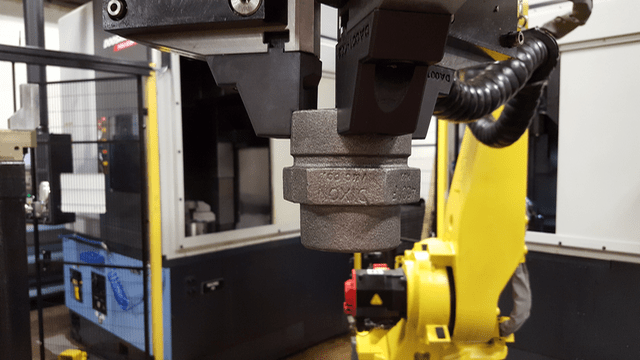
- End-use tooling and jigs on manufacturing lines, where failure causes downtime
- Functional brackets and housings that get handled, flexed, or exposed to heat in service
- Replacement parts for machinery where lead times on metal alternatives are a problem
- Aerospace and defence components where process certification matters (see AS9100 additive manufacturing guidance)
- Medical device fixtures and trays requiring sterilisation compatibility and dimensional repeatability
If you’re printing concept models, form studies, or prototypes that will never see real load, onyx is overkill. PLA or PETG on a cheaper printer will get you there faster and at a fraction of the cost. Onyx makes sense when the part has to survive contact with the real world.
Onyx With Continuous Fibre: Where Things Get Interesting
To understand why Markforged put onyx at the centre of their system, you need to look at what happens when you pair it with CFR. On compatible printers, Eiger places continuous strands of reinforcement fibre inside the part layer by layer, in locations you define or that the software optimises for your load case.
The available fibre types each change the part’s character in different ways: continuous carbon fibre for maximum stiffness and strength, fibreglass for a lower-cost alternative that still outperforms unreinforced materials significantly, HSHT (High Strength High Temperature) fibreglass for elevated temperature applications, and Kevlar where impact resistance and flexibility matter more than raw stiffness.
The performance shift is not subtle. Onyx alone has a tensile strength of around 35 MPa. Onyx with continuous carbon fibre can exceed 800 MPa tensile strength, which puts it in the same territory as 6061 aluminium at a fraction of the weight. From a desktop machine. That’s not a small thing for engineers who previously had no option other than metal for load-bearing printed parts.
The Additive-X team can walk you through which printers support continuous fibre and which combination of materials suits your application. View the Markforged printer range on the Additive-X shop, or give us a call on 01765 694 007.
A Few Practical Things Worth Knowing
Onyx is hygroscopic, as most nylon-based materials are. Markforged spools are sealed at dispatch, but once you open one, storage matters. Moisture-contaminated Onyx will print with poor layer adhesion and a rougher surface than you’d expect. A sealed dry box with desiccant is essential to preserve the material quality and prevent degradation through moisture absorption.
Print times are broadly comparable to other high-performance FFF materials, though adding continuous fibre reinforcement adds time because the fibre print head makes additional passes on each reinforced layer. For tooling and end-use parts, that’s rarely a dealbreaker, but factor it in if you’re working to tight deadlines.
Post-processing is straightforward. Onyx parts can be drilled, tapped, bonded with structural adhesive, and lightly sanded. The out-of-printer surface won’t match an SLA (Stereolithography) or SLS (Selective Laser Sintering) part for smoothness, but for most functional components it doesn’t need to.
One thing worth repeating: this is a closed ecosystem. There’s no third-party Onyx filament that works in a Markforged machine, and no route to running Onyx on an open-platform printer. If flexibility of material sourcing matters to you, that’s a genuine consideration before committing to the platform
Buying Onyx Filament in the UK
Additive-X is an authorised Markforged reseller and stocks onyx filament for UK delivery. You can order onyx filament direct from the Additive-X shop, or get in touch if you want advice on spool sizes, compatible CFR materials, or how to get the best out of the printer you already have.
The team is based in Ripon, North Yorkshire, and has been working with 3D printing technology since 2013. If you’re weighing up whether a Markforged machine is the right investment for your workflow, you can book a demo at the showroom and handle parts printed in onyx before making a decision. That’s usually a more useful exercise than reading a spec sheet.
Get in Touch or Order Direct
Browse onyx filament and Markforged materials on the Additive-X shop, or call the team on 01765 694 007 to talk through your application. If you’re not sure onyx is the right material for your project, we’ll tell you that too.