




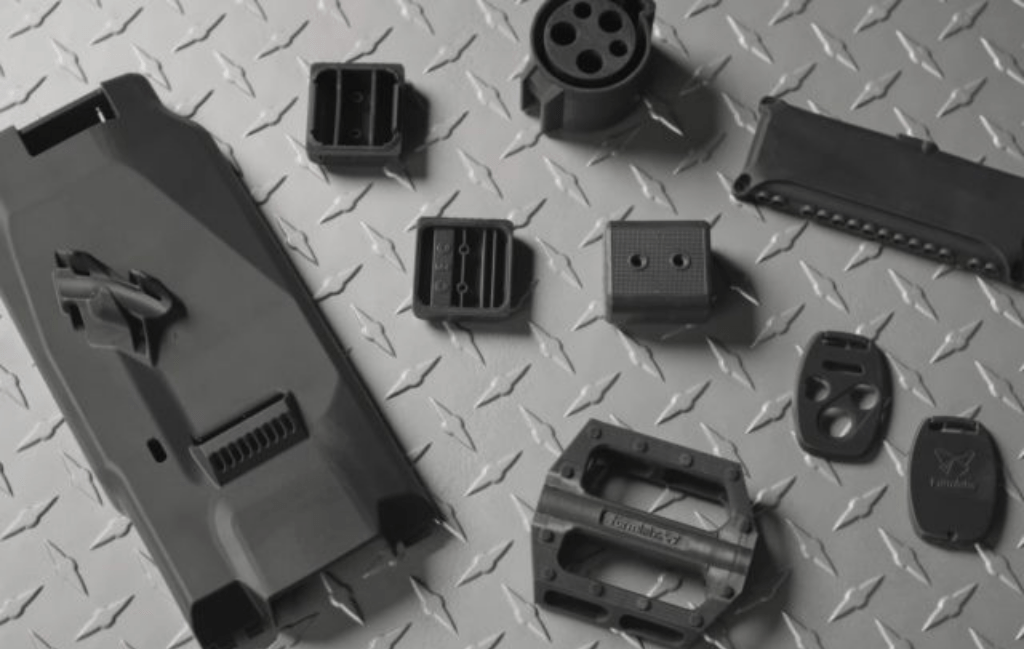
Formlabs names each resin in its Tough family after its tensile modulus in megapascals. Tough 1000 sits at the ductile, impact-resistant end. Tough 2000 is the strongest and stiffest. Tough 1500 sits in the middle, with a character closer to polypropylene than either of its siblings.
The naming makes the range straightforward to navigate, but picking the right material for a specific part requires more than knowing where each one sits on a stiffness spectrum. This Formlabs Tough Resin comparison covers the mechanical properties, comparable thermoplastics, and applications that suit each material.
The Three Materials at a Glance
All three resins are formulated for the Form 4 Series and share a dark grey, matte surface finish. They are engineering materials designed for functional prototyping, jigs, fixtures, and end-use parts. Each one rivals a familiar thermoplastic in its mechanical behaviour.
Material | Comparable Thermoplastic | Character | Primary Use |
Tough 1000 Resin | HDPE / Delrin (POM) | Most ductile, highest impact resistance | Hinges, gears, wear parts, moving assemblies |
Tough 1500 Resin V2 | Polypropylene (PP) | Balanced stiffness and compliance | Snap fits, clasps, compliant mechanisms |
Tough 2000 Resin V2 | ABS | Strongest and stiffest | Structural jigs, load-bearing fixtures, enclosures |
Formlabs Tough Resin Comparison: Key Mechanical Properties
The figures below are based on Formlabs data for parts printed on the Form 4 at 100 µm and post-cured at 70°C. Properties vary with part geometry and print orientation, so treat these as reference values rather than guarantees for every application.
Property | Tough 1000 | Tough 1500 V2 | Tough 2000 V2 |
Tensile Modulus | ~932 MPa | ~1,500 MPa | ~2,000 MPa |
Elongation at Break | 180% | 155% | 79% |
Gardner Impact Strength | 13.1 J | 3x higher vs prev. gen | Improved vs V1 |
Work of Fracture | 3,200 J/m² | 10x higher vs prev. gen | 305 J/m² (3x vs V1) |
Ross Flex Fatigue | >100,000 cycles @ 23°C | 8,000 cycles | Not primary spec |
HDT @ 0.45 MPa | 55.3°C | 66°C | 70°C |
Creep Strain (4 MPa, 2 weeks) | Improved vs Durable Resin | Good | 1.3% |
Surface Finish | Dark grey, matte | Dark grey, matte | Dark grey, matte |
Formlabs Tough 1000 Resin: The Most Ductile Option
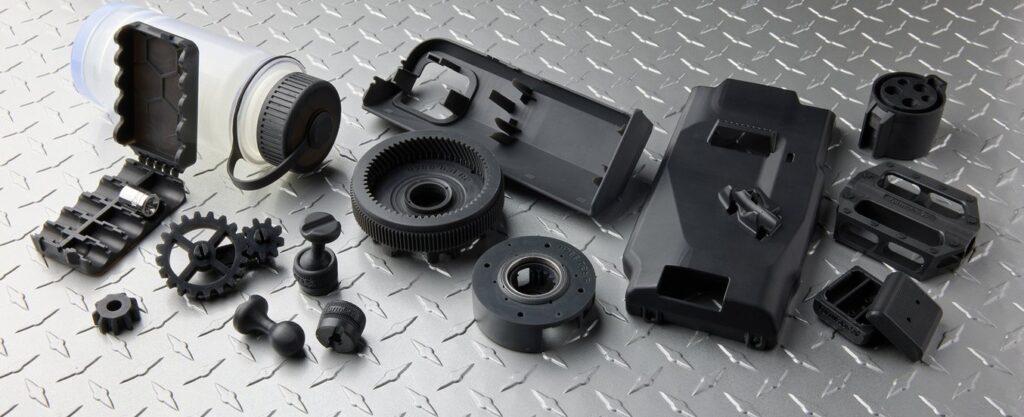
Formlabs Tough 1000 Resin is the right material when a part needs to absorb impact, flex repeatedly, or slide against other surfaces without wearing down. Its elongation at break of 180% and Gardner impact strength of 13.1 J both exceed standard extruded HDPE. The work of fracture of 3,200 J/m² tells you how much energy a part can absorb before fracturing. For a resin, that figure is high.
Lubricity is worth calling out separately. Formlabs describes Tough 1000 as comparable to Delrin (POM) in this regard, which makes it a practical choice for gears, ball joints, and moving assemblies where surfaces contact each other repeatedly. Ross flex fatigue exceeds 100,000 cycles at 23°C, giving parts the kind of longevity under cyclic loading that earlier engineering resins could not offer.
If you currently use Durable Resin, Tough 1000 is the intended replacement for demanding applications. Heat deflection is better (55.3°C versus 41°C at 0.45 MPa), creep resistance is improved, and parts resist warping during post-curing, which helps where geometry precision matters.
Good applications for Formlabs Tough 1000 Resin:
Moving assemblies, hinges, gears, and ball joints. Impact-resistant jigs and fixtures. Squeezable prototypes. End-use parts in environments involving repeated stress, wear, or freezing temperatures. Parts that previously used Durable Resin but need better temperature or creep performance.
Formlabs Tough 1000 Resin is available from Additive-X, compatible with the Form 4 Series.
Formlabs Tough 1500 Resin: Balanced Stiffness and Compliance
The V2 version of Formlabs Tough 1500 Resin is a substantial improvement on the original. Fracture toughness is 10 times higher. Gardner impact strength on thin walls is 3 times higher. These are not incremental changes.
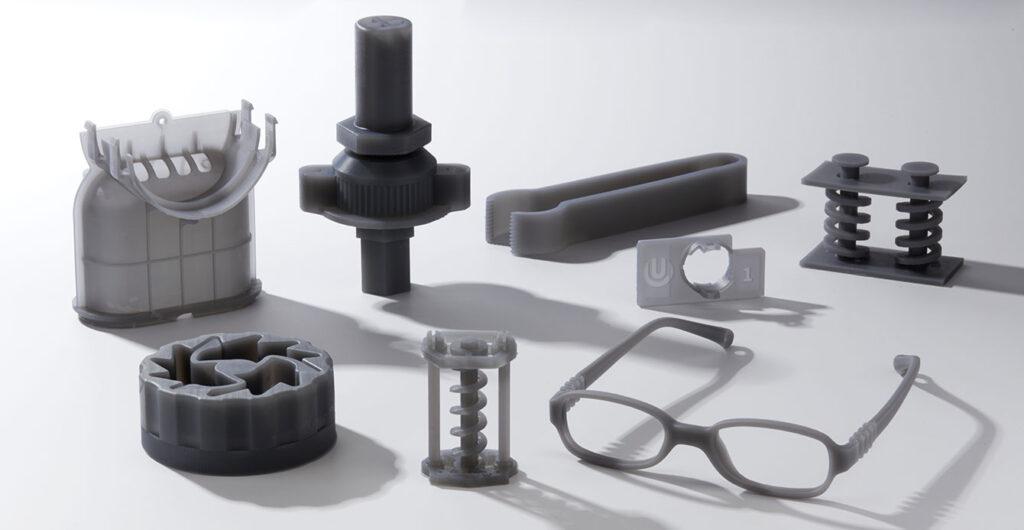
Tough 1500 V2 is the closest match to polypropylene of the three materials. PP is widely used in production because it can flex, snap, and absorb impact without shattering. Tough 1500 V2 reaches 155% elongation at break and 8,000 Ross flex fatigue cycles, which gives parts the spring-back behaviour you need for snap fits, clasps, and living hinges. A tensile modulus of around 1,500 MPa keeps the material stiff enough to hold shape under load.
The heat deflection temperature of 66°C (tested to ASTM D4459 for accelerated indoor UV aging) is the highest in the family at that test condition, making Tough 1500 a sensible choice for parts exposed to ambient light or mild heat. Formlabs also confirms that Tough 1500 Resin is certified for long-term skin contact, which opens it to wearable, consumer, and certain medical applications. See the Formlabs data sheets for current biocompatibility details.
Good applications for Formlabs Tough 1500 Resin:
Snap fits and clasps. Self-tapping screw bosses. Living hinges, latches, flexures, and dampers. Compliant mechanisms that need to deflect and return to shape. Prototyping parts whose production equivalent will be polypropylene. Applications that require long-term skin contact certification.
Tough 1500 Resin is available through Additive-X for use on Form 4 Series printers.
Formlabs Tough 2000 Resin V2: When Strength and Stiffness Come First
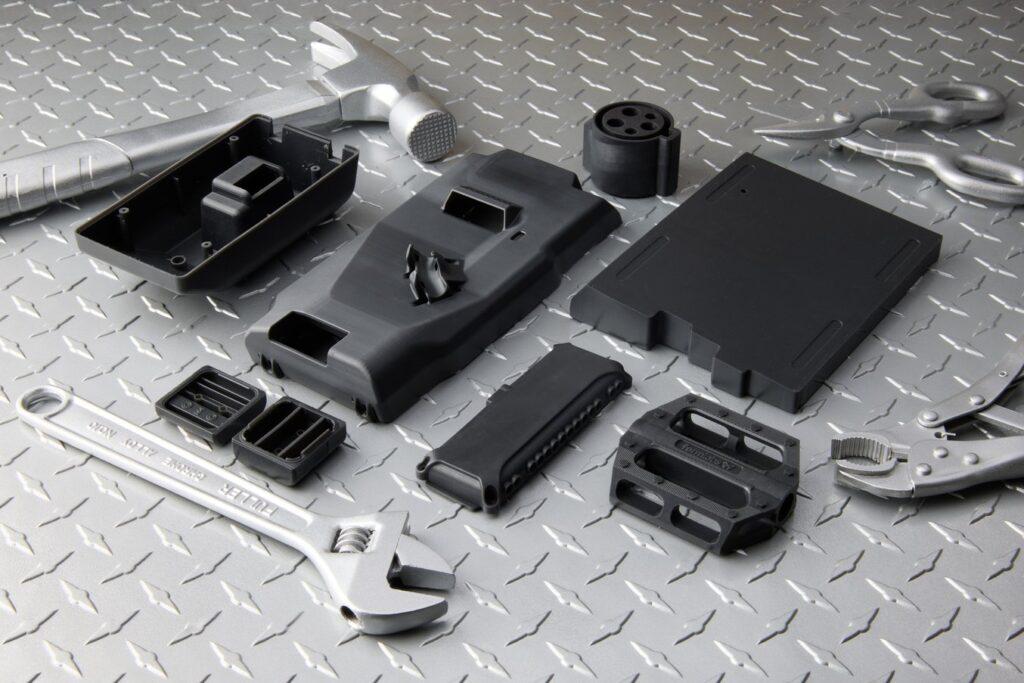
Formlabs Tough 2000 Resin V2 is the strongest and stiffest material in the family. At around 2,000 MPa tensile modulus, it sits in ABS territory. The V2 update triples fracture toughness versus V1 while keeping the rigidity that made the original useful for structural applications.
Creep resistance is the property that sets Tough 2000 V2 apart for production use. Under a sustained 4 MPa load over two weeks, the material shows only 1.3% creep strain. Parts hold their dimensions under load, which is what you need from a jig or fixture that sees repeated use on a production line. The heat deflection temperature of 70°C at 0.45 MPa is the highest in the Tough family, making it the right choice when ambient temperatures are close to the upper limits of the other materials.
The V2 surface finish is darker and more matte than V1, with better scratch resistance. For parts used in inspection processes, handed to clients, or installed in visible locations, this has practical value.
One important note: Tough 2000 V1.1 for Form 4 generation printers will no longer be available for direct purchase from August 2026. Formlabs recommends moving to V2. Contact the Additive-X team if you have questions about the transition or printer compatibility.
Good applications for Formlabs Tough 2000 Resin:
Structural enclosures and protective shells. Snap-fit assemblies that need to hold across many cycles. Jigs and fixtures requiring minimal deflection under load. Parts used at elevated temperatures up to 70°C. ABS simulation for functional prototyping and fit testing.
Which Formlabs Tough Resin Is Right for Your Application?
Start with what the part actually has to do. These questions help narrow it down.
Does the part need to flex, bend, or absorb repeated impact?
Tough 1000 handles the most abuse of the three. If the part moves, slides, or gets hit repeatedly, start here. Tough 1500 also handles flexing well, but with more stiffness and less raw impact tolerance.
Does the part need to snap or spring back?
Tough 1500 V2 is the material for snap fits, clasps, and living hinges. Its polypropylene-like balance of stiffness and compliance gives parts quick spring-back that Tough 2000 cannot reliably produce.
Does the part need to hold shape under sustained load or elevated temperature?
Tough 2000 V2 is the right choice. Its creep resistance and 70°C heat deflection temperature make it the most stable of the three under mechanical and thermal stress.
Are you replacing an existing material?
- Replacing Durable Resin: use Tough 1000 for better temperature resistance, creep performance, and dimensional stability during post-curing.
- Prototyping a polypropylene part: use Tough 1500 to match PP behaviour in deflection and snap-fit testing.
- Prototyping an ABS part: use Tough 2000 to match the stiffness and strength of ABS without brittle failure.
Post-processing is consistent across all three. Wash in IPA or an ether-based solvent after printing. Allow parts to air dry (30 minutes for Tough 1000, 10 minutes for Tough 1500 and Tough 2000), then post-cure. Formlabs recommends a Form Cure at 70°C for 12 minutes for all three V2 formulations to reach full mechanical properties.
Printer Compatibility
Tough 1000, Tough 1500 V2, and Tough 2000 V2 all require a Form 4 Series printer (Form 4, Form 4B, Form 4L, or Form 4BL). The V2 performance improvements rely on the Low Force Display (LFD) technology in these machines and are not available on Form 3 Series hardware. Earlier versions of Tough 1500 and Tough 2000 V1 remain available if you are still running Form 3 Series printers.
If you are considering a move to the Form 4 Series, the Additive-X team can arrange a demonstration at our Ripon showroom. We stock and support the machines we sell, so we can show you these materials in practice before you commit. Get in touch to book a visit or ask any questions.