




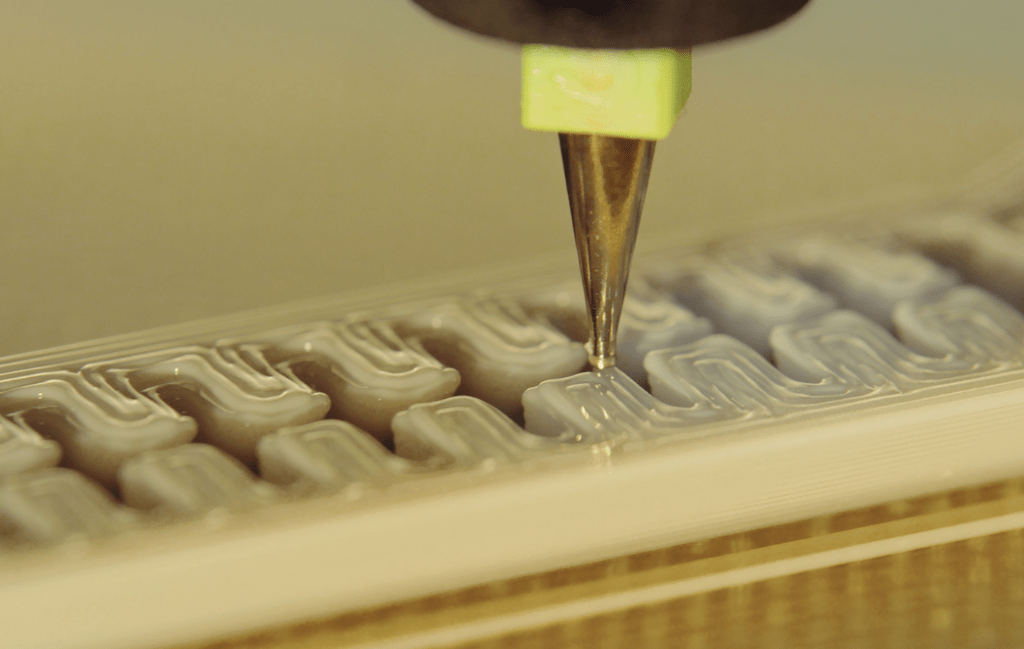
Silicone 3D printing has moved from specialist research labs into genuine industrial use, and the applications are widening quickly. Custom respiratory masks, aerospace seals, soft robotic components, and patient-specific prosthetics are all being produced today using additive manufacturing (AM) processes that were simply not viable a decade ago.
This guide covers how silicone 3D printing actually works, why silicone has historically been difficult to print, which technologies and machines are now making it practical, and where the technology is being applied across sectors. If you are evaluating whether silicone 3D printing is right for your application, or you want to understand the technical landscape before making a hardware decision, this is a good place to start.
What Makes Silicone Difficult to 3D Print?
Silicone is well established across industries. Its combination of flexibility, thermal stability, chemical resistance, and biocompatibility has made it the go-to material for medical implants, automotive seals, food-contact applications, electrical insulation, and wearable devices. But those same properties that make silicone so useful also make it notoriously difficult to process with conventional 3D printing methods.
Standard FFF/FDM (Fused Filament Fabrication) printers work by melting a solid thermoplastic filament and depositing it in layers. Silicone, in its raw form, does not melt. It is a two-part room temperature vulcanising (RTV) elastomer that begins as a liquid and cures through a chemical reaction, not a thermal one. As Wevolver notes in its technical overview of the subject, silicone can withstand temperatures from -60°C to 230°C, which rules out the heat-based approaches that work perfectly well for PLA or ABS. Pour liquid silicone into a standard print nozzle and it will simply flow out without holding any shape.
This is why, for a long time, making silicone parts meant using moulds. Injection moulding and compression moulding both work well at volume, but they require expensive tooling, long lead times, and are poorly suited to low-batch or highly customised production. However, 3D printing itself offers a compelling middle ground here: SLA printers such as those from Formlabs can be used to print the mould directly, dramatically reducing tooling costs and lead times compared to traditional CNC-machined metal moulds, while still allowing conventional silicone casting materials to be used. Formlabs demonstrates this approach with their SLA printers and Clear Resin, producing smooth, high-precision mould tools suitable for casting RTV silicone parts in low-to-medium volumes. See their overview here: Formlabs: Silicone Casting with SLA Molds. If your application needs a part that is geometrically complex, patient-specific, or produced in small numbers, traditional moulding presents real practical problems — but 3D printed mould tooling can bridge the gap before you commit to full production tooling.
How Does Silicone 3D Printing Work?
Several different approaches to silicone 3D printing have emerged, each with different trade-offs in terms of resolution, material compatibility, print speed, and suitability for regulated sectors.
Liquid Additive Manufacturing (LAM)
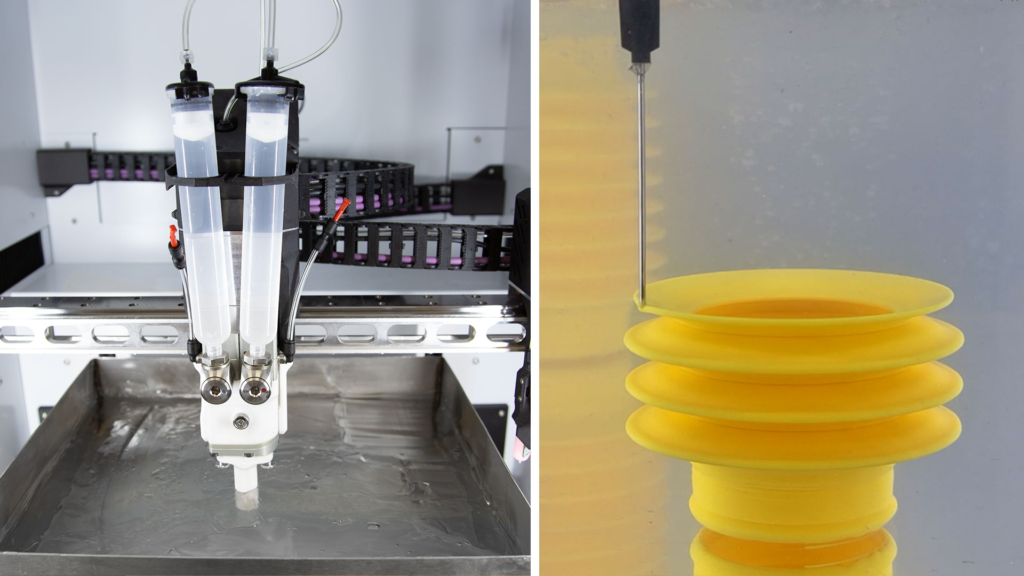
LAM is the approach used by Lynxter in its S300X and S600D printers. The system uses precision-controlled extrusion to deposit liquid silicone layer by layer, with each layer curing before or during the next is applied. The two-component LIQ21 toolhead mixes the silicone’s two components immediately before deposition, while the single-component LIQ11 toolhead handles single-part formulations and water-soluble support materials.
The result is a process that handles true RTV2 silicone, the same industrial and medical-grade material used in conventional manufacturing, without requiring the silicone to be reformulated or compromised. The Lynxter S300X has a build volume of 300 mm x 250 mm x 200 mm and prints at layer heights from 100 μm to over 1 mm, giving reasonable resolution for most industrial and medical applications.
Stereolithography (SLA) with Silicone-Like Resins
Formlabs has taken a different approach with its Silicone 40A Resin, compatible with the Form 3+ and Form 3B+ SLA printers. Rather than depositing liquid silicone directly, the material is a photopolymer resin engineered to mimic silicone’s mechanical behaviour once cured, achieving 40A Shore hardness, a tear strength of 12 kN/m, and an elongation at break of 230%.
The advantage here is that SLA printers are already widely deployed, relatively affordable, and capable of high-resolution output. The Formlabs approach does not print true silicone, but the material properties are close enough for a wide range of applications including wearables, custom prosthetics, orthotics, flexible consumer products, and soft moulds. You can explore the full range of Formlabs specialty materials in the Additive-X shop.
Silicone Filament Extrusion
A newer approach, introduced publicly at Formnext 2024 by Filament2, embeds silicone paste inside a hollow filament carrier that feeds into a standard FDM printer. A cutting nozzle strips the outer layer during extrusion, depositing pure silicone onto the build plate. This lowers the barrier to entry significantly, though the technology is still early-stage compared to dedicated LAM systems.
Key Properties of 3D Printed Silicone
Understanding what silicone actually offers as a 3D printing material helps clarify which applications it suits well and which it does not.
- Flexibility and elasticity: silicone stretches, bends, and compresses without losing its original shape, making it suitable for parts that need to accommodate movement, vibration, or repeated deformation.
- Thermal stability: a typical service range of -60°C to 230°C, with specialist formulations tolerating up to 300°C. This is well beyond what most thermoplastics can manage.
- Chemical resistance: resistant to oils, acids, alkalis, and many solvents, which matters in automotive, industrial, and laboratory contexts.
- Biocompatibility: medical-grade RTV2 silicones certified to ISO 10993-05 for skin contact are available, making the material suitable for medical devices and direct patient-facing applications.
- Electrical insulation: silicone is a poor conductor of electricity, useful in electronics and wiring applications requiring flexible insulation.
- Weather and UV resistance: does not degrade significantly when exposed to outdoor conditions, unlike many plastics.
No single material is right for every application, and silicone has limitations too. It is generally more expensive than common thermoplastics. Printing speeds with LAM technology are relatively slow compared to FFF. And while the mechanical properties of 3D printed silicone parts are good, they may not be identical to injection-moulded equivalents, depending on the material and process used.
Where Is Silicone 3D Printing Being Used?
Medical and Biomedical Applications
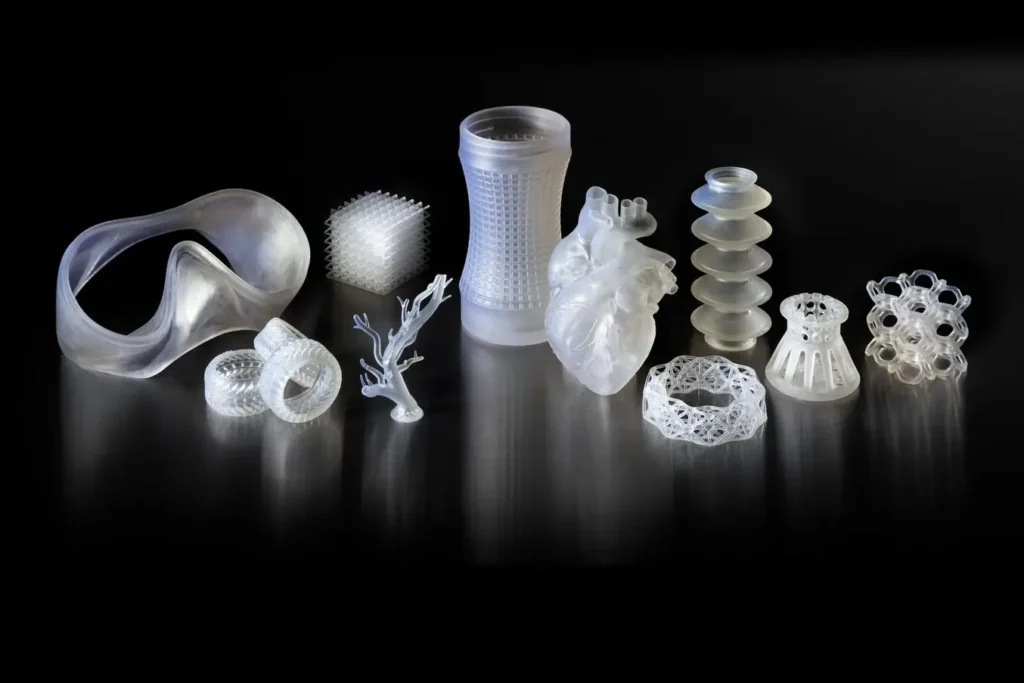
This is the sector driving most of the current investment in silicone 3D printing, and for understandable reasons. Silicone’s biocompatibility, flexibility, and ability to be sterilised make it well suited to direct patient use. Custom prosthetics, orthotics, respiratory masks, surgical training models, and implantable devices are all being produced or investigated using additive approaches.
The ability to produce patient-specific parts is particularly significant here. A custom respiratory mask for a newborn, a personalised orthotic that matches a patient’s exact anatomy, or a surgical simulation model based on a specific patient’s scan are all things that conventional moulding struggles to deliver economically. 3D printing changes the economics of customisation entirely.
Lynxter has worked with AP-HP (Assistance Publique Hôpitaux de Paris) on custom respiratory masks for newborns and with research teams investigating silicone anatomical models for surgical training. 3Deus Dynamics, whose Dynamic Molding Technology is compatible with Lynxter’s S300X platform, has produced anatomical aortic models used in vascular surgery training at institutions including Rigshospitalet in Copenhagen.
For teams looking to explore silicone 3D printing for medical applications, the Lynxter S300X is the most capable dedicated silicone printer currently available. Its compatibility with RTV2 medical-grade silicone certified under ISO 10993-05 makes it a practical option for regulated environments.
Aerospace and Defence
Aerospace is another area where silicone’s material properties translate directly into component requirements. Seals, gaskets, vibration dampeners, and electrical insulation parts all need to tolerate wide temperature ranges, chemical exposure, and sustained mechanical stress. Conventional manufacturing of custom or low-volume silicone parts for aerospace has always been expensive due to tooling costs.
Lynxter’s work with Airbus, which supported the company from its earliest days, highlighted the potential here. 3Deus Dynamics has taken this further with enhanced silicone formulations incorporating properties such as electromagnetic shielding, fire resistance, and conductivity. An electromagnetic shielding silicone seal has already been validated in flight on a helicopter, demonstrating that 3D printed silicone parts can meet aerospace-grade requirements in practice.
Industrial Manufacturing
For manufacturers, silicone 3D printing addresses a specific problem: producing custom seals, gaskets, surface treatment masks, and low-volume components without the lead time and cost of traditional tooling. If a seal fails and the mould no longer exists, reproducing it through conventional means can take weeks. Printing a replacement from a CAD file can take hours.
Industrial applications also include soft robotic grippers, actuators, and sensors, where silicone’s elasticity is an inherent advantage. Electronics encapsulation and thermal management components are a further use case, where silicone can protect delicate assemblies from heat, moisture, and mechanical stress.
Prototyping and Product Development
Product teams working with flexible components have historically had to make a significant investment before they could hold a functional prototype. Silicone 3D printing removes that barrier. Designers can produce a silicone prototype, test it against real performance requirements, adjust the CAD model, and reprint, all without committing to tooling.
For teams working with the Formlabs ecosystem, Silicone 40A Resin opens up silicone-like prototyping on hardware that many studios already own. For teams needing genuine silicone with specific hardness characteristics, the Lynxter approach delivers true RTV2 material in a production-capable format. The Additive-X speciality materials page covers both options in more detail.
Silicone 3D Printing Hardware: What to Consider
Choosing the right hardware depends heavily on what you are trying to achieve. Here are the main variables worth considering.
True Silicone vs Silicone-Like Materials
LAM-based systems such as the Lynxter S300X and S600D print genuine RTV2 silicone, which is important if your application has material certification requirements or if you need the specific mechanical properties of true silicone. SLA-based approaches using materials such as Formlabs Silicone 40A Resin produce parts that behave like silicone but are chemically different. Both are useful, but for different applications.
Shore Hardness Requirements
Shore hardness (ShA) determines how soft or firm the finished part is. The Lynxter S300X supports RTV2 medical-grade silicone at 5, 10, 25, and 40 ShA, industrial-grade silicone at 45 ShA, and polyurethane from 50 to 85 ShA. Formlabs Silicone 40A Resin targets the 40 ShA range specifically. Knowing the hardness requirements of your application before evaluating hardware will help narrow the options considerably.
Build Volume and Part Size
The Lynxter S300X offers a build volume of 300 mm x 250 mm x 200 mm. The larger S600D extends to Ø390 mm x 600 mm, which suits bigger industrial components. Formlabs printers vary by model; the Form 3L and Form 3BL offer larger build platforms if you need scale with SLA.
Support Structures
Printing complex geometries in silicone requires support structures, which need to be removable without damaging the part. The Lynxter S300X uses a water-soluble support material via its LIQ11 toolhead, which is removed by rinsing rather than mechanical means. This enables complex overhanging geometries and internal features that would be difficult or impossible to achieve otherwise.
The Lynxter Range: Silicone Printing for Professional Use
Additive-X is a UK distributor for Lynxter, and both of the company’s current LAM-capable printers are available through the shop.
The Lynxter S300X is Lynxter’s dedicated silicone printer, built specifically around the LIQ21 and LIQ11 toolheads. It has a filtered, heated, and soundproofed build chamber with dual HEPA H14 and activated carbon filtration. Large-capacity cartridges allow for autonomous longer print runs without constant intervention. It is well suited to medical device manufacturers, research institutions, and industrial teams producing custom silicone components at low to medium volumes.
The Lynxter S600D is the more versatile machine, with a modular quick-change toolhead system that supports filament, liquid, and paste printing across the same platform. If your production environment needs to handle thermoplastics, silicones, and ceramics without separate hardware, the S600D is worth evaluating. Its build volume (Ø390 mm x 600 mm) suits larger industrial applications.
Both machines are manufactured at Lynxter’s facility in Bayonne, France, and Lynxter takes an open approach to materials, sharing procedures and actively working with users on new formulations.
You can browse the full Lynxter range in the Additive-X shop, or speak to the team for a demonstration at the Ripon showroom.
Formlabs Silicone 40A Resin: A Lower-Barrier Entry Point
For teams that already have Formlabs SLA hardware, or who want to explore silicone-like printing at a lower capital cost, Formlabs Silicone 40A Resin is a practical starting point. It is compatible with the Form 3+ and Form 3B+, and produces parts with properties well suited to wearables, flexible consumer products, custom orthotics, and soft moulds.
Key properties of Silicone 40A Resin include 40A Shore hardness, a tear strength of 12 kN/m, elongation at break of 230%, and a thermal stability range of -25°C to 125°C. It is softer and more flexible than Elastic 50A Resin, with better fatigue resistance, though it is not chemically identical to conventional silicone and does not carry medical-grade certifications for skin contact.
Browse Formlabs resins and hardware in the Additive-X shop for current pricing and availability.
Silicone 3D Printing vs Traditional Moulding: A Practical Comparison
For volume production of standard parts, conventional moulding remains cost-competitive. But the comparison shifts considerably when you factor in complexity, customisation, batch size, and time to first part.
- Tooling cost: moulding requires an upfront mould that can cost thousands of pounds before a single part is produced. 3D printing has no tooling cost; the cost is in the machine and material.
- Lead time: a new mould typically takes weeks to produce and validate. A 3D printed part can be ready within hours of finalising a CAD file.
- Customisation: each 3D printed part can be unique without additional cost. Customisation in moulding adds significant complexity and expense.
- Geometric complexity: support-enabled LAM printing can produce internal channels, undercuts, and geometries that would require multi-part moulds or be impossible to demould.
- Volume: moulding is usually more cost-effective above a few hundred identical parts. Below that threshold, or for one-off or bespoke production, 3D printing is often the better economic choice.
Is Silicone 3D Printing Right for Your Application?
The answer depends on what you are making, how many parts you need, and what material performance you require. Silicone 3D printing is not a replacement for high-volume moulded production. It is, however, a practical and increasingly well-validated route for custom parts, complex geometries, low-to-medium volume production, and applications where the properties of silicone are essential.
If you are working in medical devices, aerospace, industrial sealing, soft robotics, or product development with flexible components, the technology is worth a closer look. The hardware is now mature enough to produce parts that meet regulated industry standards, and the material range continues to expand.
The Additive-X team can provide demonstrations at our Ripon showroom, sample parts, and technical guidance on whether a Lynxter or Formlabs-based silicone solution suits your use case. Browse the full Additive-X shop or call us on 01765 694 007 to speak to a specialist.