




Choosing an industrial 3D printer is not simply a question of build volume or print speed. For manufacturers, the more important decision is how a printing technology will perform within an actual production workflow. Can it produce a jig that withstands repeated use? Can it manufacture complex nylon components in batches? Will it deliver the dimensional accuracy and surface finish required for a functional prototype or casting pattern?
Four technologies dominate industrial additive manufacturing: FFF (Fused Filament Fabrication), SLS (Selective Laser Sintering), SLA (Stereolithography) and metal 3D printing. Each has different capabilities, material requirements and production considerations. Selecting the wrong process can increase finishing time, material costs and production delays, even if the initial machine investment appears attractive.
This guide compares the four technologies through their manufacturing applications, material capabilities, production limitations and operating requirements. It also looks at specific industrial 3D printers available through Additive-X to help you identify which solution best fits your operation.
What should manufacturers look for in an industrial 3D printer?
An industrial 3D printer should be evaluated according to the requirements of the parts it needs to produce, rather than its specifications alone.
For a manufacturing business, five considerations are particularly important.
- Mechanical performance
A component used as a machine bracket has different requirements from a visual prototype. Consider the forces it will experience, its operating temperature and whether it needs to withstand repeated loading. Material selection and print orientation can significantly influence the finished part’s performance.
- Production volume
A machine that produces an excellent individual prototype may not be the most economical option for producing hundreds of components. Consider build capacity, the number of parts that fit into a print job and the time required for post-processing.
- Dimensional accuracy and surface finish
Assembly components, inspection fixtures and precision tooling need to meet specific dimensional requirements. Meanwhile, presentation models and casting patterns may require smoother surfaces and finer detail.
- Material compatibility
The available material range determines what applications a machine can support. Engineering thermoplastics, continuous fibre composites, nylon powders, photopolymer resins and metal feedstocks each offer different mechanical and physical properties.
- Total production cost
The purchase price is only one part of the investment. Material consumption, operator time, post-processing equipment, maintenance and production throughput all contribute to the actual cost per component.
With these requirements established, the next step is to compare what each printing technology can deliver.
1. Industrial FFF: Manufacturing functional parts, jigs and fixtures
FFF is one of the most widely used additive manufacturing processes for producing functional plastic components. It works by heating thermoplastic filament and depositing it through a nozzle, building the component layer by layer.
For manufacturers, the main advantage is the ability to produce functional parts using a broad selection of engineering materials without the complexity of powder-based or resin-based systems.
Where industrial FFF makes the biggest difference
One of the most practical applications is manufacturing aids and production tooling.
Consider an assembly line that uses a dedicated fixture to hold components in position during drilling, bonding or inspection. Traditionally, this fixture might require machining from a solid block of material. With industrial FFF, it can be designed around the exact geometry of the component, printed in-house and modified when the production process changes.
Common applications include:
- Jigs and fixtures: Custom holders, alignment guides and positioning tools for assembly operations.
- Machine components: Brackets, housings, protective covers and replacement parts.
- End-of-arm tooling: Lightweight grippers and custom attachments for robotic systems.
- Functional prototypes: Components that need to be evaluated for fit, assembly and mechanical performance before production.
- Lightweight structural components: Reinforced plastic parts designed to replace heavier metal components in suitable applications.
Continuous fibre reinforcement: Moving beyond standard thermoplastics
For applications requiring greater structural performance, continuous fibre reinforcement is an important development in industrial FFF.
Unlike conventional filament printing, which relies on the properties of the thermoplastic material, Continuous Fibre Reinforcement (CFR) technology incorporates continuous carbon or glass fibre into selected printed components.
The reinforcement can significantly increase stiffness and strength in the appropriate loading directions, making it possible to manufacture lightweight tooling and structural components that would otherwise require metal.
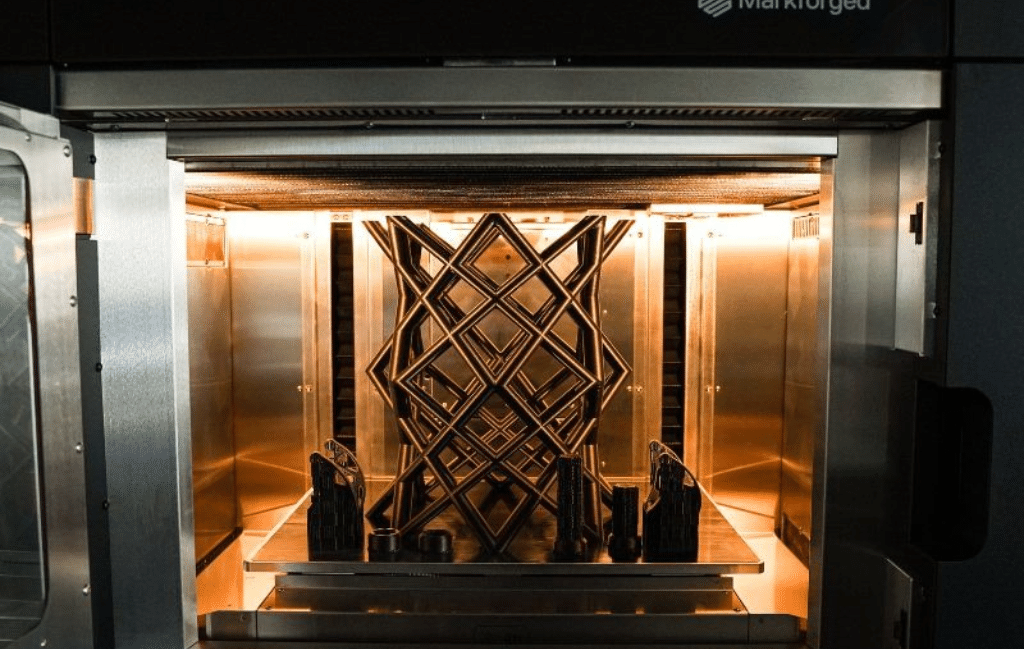
For example, the Markforged FX20 is designed for large-format composite manufacturing. The 3DGence Industry range is another option for manufacturers working with demanding engineering polymers.
When should you choose industrial FFF?
Choose FFF when your production requires functional thermoplastic components, custom tooling, lightweight fixtures or reinforced composite parts. It is particularly useful when designs change frequently and manufacturing teams need to produce replacement tooling or components in-house.
Its main limitations are visible layer lines, anisotropic mechanical properties and the need to consider support structures for certain geometries. For applications requiring very smooth surfaces or intricate details, SLA may be more appropriate.
2. Industrial SLS: Producing complex nylon components in batches
SLS uses a laser to fuse particles of polymer powder together, creating solid components layer by layer inside a powder bed.
Its biggest manufacturing advantage is that the surrounding unfused powder supports the component during printing. Unlike FFF and SLA, SLS does not normally require dedicated support structures.
This changes how parts can be arranged within a build chamber and makes the process particularly useful for producing complex components in batches.
Why support-free printing matters in production
Imagine a manufacturer producing 100 custom enclosures with internal channels, clips and interlocking features.
With processes requiring support structures, these features may need additional design considerations and post-print support removal. With SLS, the surrounding powder supports the geometry, allowing more freedom when designing intricate components.
The ability to nest parts throughout the build volume also makes SLS attractive for batch production. Rather than arranging components only across a flat build plate, manufacturers can utilise the available three-dimensional chamber space.
Typical applications include:
- Enclosures and housings: Complex components with internal features and integrated mounting points.
- Functional prototypes: Parts that need to be evaluated for fit, movement and mechanical performance.
- Small-batch production: Custom components produced in quantities that may not justify injection moulding.
- Ducting and fluid-related components: Geometries with internal passages and complex shapes, subject to material suitability.
- Custom equipment components: Lightweight parts for machinery, instruments and specialist assemblies.
Which SLS materials are suitable?
Nylon is one of the most established materials used in polymer SLS.
Different nylon formulations offer different combinations of strength, flexibility, durability and thermal performance. The appropriate material depends on the component’s operating environment and mechanical requirements.
For example, nylon components are useful for functional housings, brackets, clips and other parts that need to withstand repeated handling.
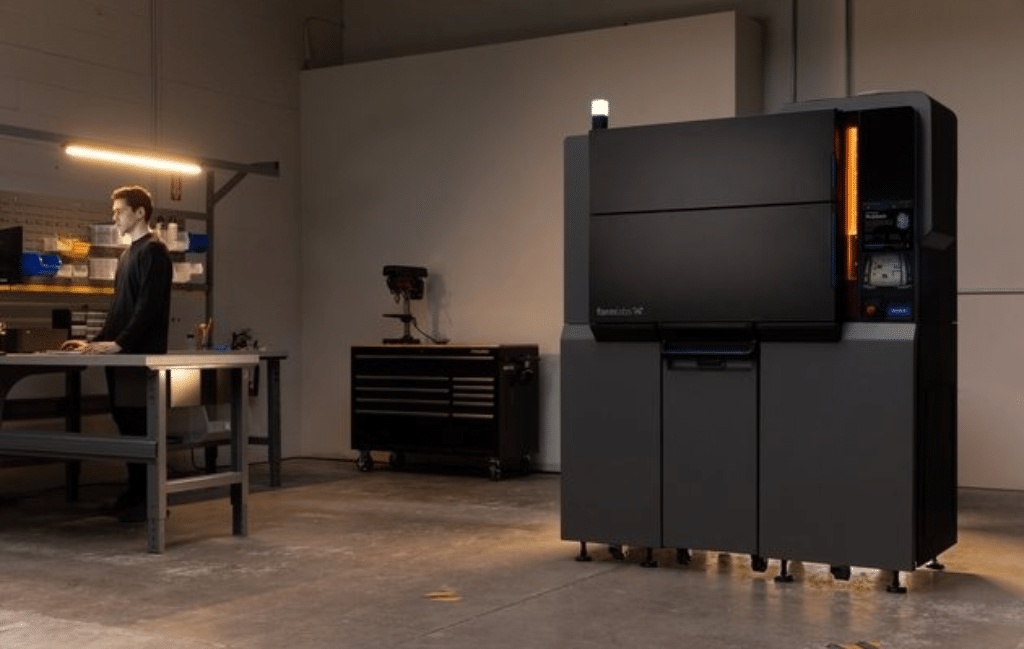
The Formlabs Fuse 1+ 30W brings industrial SLS capabilities into a benchtop system, making the technology more accessible to businesses that need functional nylon production without the footprint of larger industrial installations.
What are the limitations of SLS?
SLS parts typically have a grainier surface finish than SLA components. If the application requires a smooth appearance, additional finishing may be necessary.
The process also involves powder handling, removal of excess powder and appropriate powder management. These steps need to be considered when calculating production time and operating costs.
When should you choose SLS?
SLS is particularly suitable when you need complex nylon components, support-free geometries or multiple functional parts produced within the same build. It is worth considering for businesses manufacturing small batches of end-use components or frequently changing product designs.
3. Industrial SLA: Precision components, patterns and detailed models
SLA uses light to selectively cure liquid photopolymer resin, creating solid components layer by layer.
Where FFF and SLS are often selected for functional thermoplastic parts, SLA is particularly valuable when dimensional detail and surface quality are the main priorities.
It can produce intricate geometries, fine features and smooth surfaces that would require additional finishing with other processes.
Where SLA fits into industrial manufacturing
One important application is producing patterns and masters for moulding and casting.
A manufacturer can create a detailed pattern directly from a CAD model, inspect its geometry and use it as part of a subsequent casting or mould-making process. This reduces the need to machine a physical master from solid material.
SLA is also useful for producing:
- Casting patterns: Detailed masters for jewellery, engineering and other casting applications.
- Mould masters: Components used to create moulds for subsequent manufacturing processes.
- Precision prototypes: Parts used to evaluate complex shapes, small features and assembly details.
- Dental and medical models: Detailed models where dimensional definition is important.
- Presentation models: Components requiring smooth surfaces and a high-quality appearance.
Choosing the right resin
One of SLA’s biggest advantages is its range of specialised photopolymer materials.
Depending on the resin, applications can include:
- Tough materials for functional prototyping.
- Flexible materials for parts requiring deformation.
- Castable materials for investment casting workflows.
- Heat-resistant materials for applications involving elevated temperatures.
However, resin properties vary considerably. A resin suitable for a detailed presentation model may not be appropriate for a component exposed to repeated mechanical stress.
Large-format SLA for industrial applications
For manufacturers working with larger components, the Formlabs Form 4L provides a large-format resin printing option.
Its larger build area is useful when producing components that would otherwise need to be divided into smaller sections and assembled afterwards.
This can be particularly valuable for large prototypes, patterns and detailed models where a continuous surface is preferable.
What should you consider before investing in SLA?
SLA requires post-processing after printing. Parts need to be washed to remove residual resin and cured according to the material requirements.
This means manufacturers must account for additional equipment, handling time and consumables.
Resin components also have different mechanical characteristics from nylon and reinforced thermoplastics. If a part needs to withstand substantial impact or repeated loading, its suitability should be evaluated carefully.
When should you choose SLA?
SLA is the preferred option when fine detail, smooth surfaces and accurate reproduction of complex geometries are more important than producing large quantities of functional thermoplastic parts.
It is particularly relevant for casting patterns, detailed prototypes, dental models and applications where surface quality directly affects the next manufacturing stage.
4. Metal 3D printing: Manufacturing complex metal components in-house
Metal additive manufacturing allows businesses to produce components from materials such as stainless steel and other metal alloys.
It is particularly valuable when conventional machining would involve substantial material removal, complex tooling or lengthy production lead times.
However, metal printing is not a single process. Different technologies use different feedstocks and consolidation methods, and the choice affects material performance, equipment requirements and post-processing.
Markforged Metal X: A different approach to metal printing
The Markforged Metal X uses bound-metal filament technology.
Instead of directly melting metal powder with a high-powered laser, the system prints a component using metal powder held within a polymer binder.
The printed component, known as a green part, then undergoes a washing process to remove the binder before being sintered in a furnace. During sintering, the metal particles bond together to form the final metal component.
This workflow makes metal additive manufacturing accessible to businesses that may not require or be able to justify a larger laser powder-bed fusion installation.
Where metal 3D printing is useful
Metal printing is particularly relevant for components where the material itself is essential to the application’s performance.
Manufacturing applications include:
- Replacement machine components: Producing specialist metal spares when conventional sourcing involves long lead times.
- Custom tooling: Manufacturing metal fixtures and tooling for specific production requirements.
- Complex geometries: Creating shapes that would be difficult or expensive to machine using conventional methods.
- Low-volume components: Producing specialist parts without investing in dedicated tooling for larger production runs.
- Lightweight designs: Manufacturing optimised geometries that reduce material usage where the application permits.
What are the trade-offs?
Metal 3D printing requires more extensive post-processing than many polymer printing methods.
For the Metal X workflow, this includes washing and furnace sintering. Manufacturers must also account for dimensional changes during sintering and design parts accordingly.
The equipment investment, material costs and additional processing requirements mean metal printing is not automatically the most economical option.
For many applications, reinforced polymer components can provide a suitable alternative at a lower cost. Metal becomes relevant when the component genuinely requires metal properties that polymer processes cannot provide.
When should you choose metal 3D printing?
Choose metal when the component requires metal material performance, has a complex geometry or is expensive and time-consuming to manufacture using conventional machining.
For businesses producing specialist tooling, replacement parts and low-volume metal components, the Markforged Metal X provides an alternative manufacturing route worth evaluating.
Industrial 3D printing technologies compared
The following comparison summarises how the four processes differ in a manufacturing environment.
Requirement | FFF | SLS | SLA | Metal |
Primary materials | Thermoplastics and reinforced composites | Nylon and polymer powders | Photopolymer resins | Metal alloys |
Main advantage | Functional parts and reinforced tooling | Complex parts without dedicated supports | Fine detail and smooth surfaces | Metal components with complex geometries |
Typical applications | Jigs, fixtures, brackets and housings | Functional nylon parts and small batches | Patterns, masters and precision models | Metal tooling, spares and components |
Surface finish | Visible layer lines | Powder-grain texture | Smooth, detailed finish | Depends on process and finishing |
Support requirements | Often required | Not normally required | Often required | Depends on process |
Post-processing | Support removal and finishing where needed | Powder removal and finishing | Washing and curing | Process-dependent, including washing and sintering for Metal X |
Production advantage | Cost-effective tooling and functional parts | Efficient nesting of multiple parts | High-detail component production | In-house manufacture of specialist metal parts |
No single technology is suitable for every manufacturing requirement. The most effective process depends on the material, geometry, mechanical properties and production quantity of the component.
Which industrial 3D printing technology should your business invest in?
Understanding the differences between printing processes is useful, but the investment decision should ultimately be based on your existing manufacturing workflow.
Consider these four scenarios.
Scenario 1: Your factory regularly needs custom jigs and fixtures
If your production team frequently designs and replaces assembly fixtures, industrial FFF is a strong starting point.
You can manufacture tooling in-house, modify designs when components change and use reinforced materials for applications requiring greater stiffness and strength.
A continuous fibre system such as the Markforged range is worth considering when standard thermoplastics do not meet the mechanical requirements.
Scenario 2: You need to manufacture batches of complex plastic components
If you produce multiple functional components with intricate geometries, SLS may offer a more suitable workflow.
The absence of dedicated support structures makes it easier to nest components within the build chamber, while nylon materials provide options for functional end-use parts.
This makes SLS particularly relevant for small-batch manufacturing and customised components.
Scenario 3: Your prototypes need fine detail and smooth surfaces
If your team produces detailed models, casting patterns or components that need a high-quality surface finish, SLA is worth evaluating.
A machine such as the Formlabs Form 4L provides a large-format resin printing option for producing detailed components without having to divide every large model into smaller sections.
Scenario 4: You need specialist metal components without outsourcing every job
If your business regularly requires complex metal tooling, replacement parts or low-volume components, metal additive manufacturing may be worth bringing in-house.
The Markforged Metal X offers a bound-metal filament workflow that uses washing and sintering rather than direct laser melting of metal powder.
The decision should account for the complete processing workflow, not just the printing stage.
Industrial 3D printer costs: What should manufacturers calculate?
Comparing machines based solely on their purchase prices can lead to misleading investment decisions.
A more useful approach is to calculate the total cost of producing a finished component.
Consider the following factors:
Material cost per part
Compare the amount of filament, powder, resin or metal feedstock required for each component. Also consider waste, material recovery where applicable and the cost of specialised engineering materials.
Post-processing requirements
A printed component is not necessarily ready for use immediately. SLS requires powder removal, SLA requires washing and curing, and the Metal X workflow involves washing and sintering. FFF may also require support removal and surface finishing.
Production capacity
Calculate how many components can be produced in one build and how long the complete production cycle takes. For SLS, the ability to nest multiple components can influence the economics of batch production.
Labour and operating requirements
Include operator time, preparation, machine handling, post-processing and maintenance. A machine with a lower material cost may not necessarily have the lowest total production cost.
Equipment and facility requirements
Some technologies require additional equipment for post-processing, material handling and storage. These requirements should be included in the initial investment assessment.
A useful starting point is to compare the total production cost against your current manufacturing method, whether that involves machining, outsourcing or purchasing components from a supplier.
When should you move from desktop to industrial 3D printing?
Not every manufacturing application requires an industrial machine. Capable desktop printers can handle many prototyping and low-volume production requirements.
However, an industrial system becomes more relevant when your business needs:
- Reinforced engineering materials for demanding functional applications.
- Larger build volumes or specialised manufacturing processes.
- More consistent production workflows.
- Dedicated equipment for continuous production requirements.
- Specialist materials and processes such as SLS or metal additive manufacturing.
The transition should be driven by a clear production requirement. If a desktop printer already produces the required component reliably and economically, upgrading simply for the sake of having an industrial machine may not be justified.
For many businesses, the most sensible approach is to identify a recurring manufacturing problem, evaluate the potential savings and test the technology against actual production parts before committing to an investment.
Final thoughts: Match the technology to the manufacturing requirement
Choosing an industrial 3D printer requires a clear understanding of what your business needs to manufacture.
FFF is particularly useful for functional thermoplastic components, production tooling and reinforced composite parts. SLS is suited to complex nylon components and batch production without dedicated support structures. SLA delivers fine detail and smooth surfaces for patterns, models and precision applications. Metal printing provides an alternative route for manufacturing specialist metal components and tooling.
The right investment is not necessarily the machine with the largest build volume or the most advanced specifications. It is the system that produces your required components at the right quality, cost and production rate.
At Additive-X, we supply industrial 3D printing solutions from manufacturers including Markforged, Formlabs and 3DGence. Our team can help you compare technologies, evaluate material options and identify equipment suited to your manufacturing requirements.